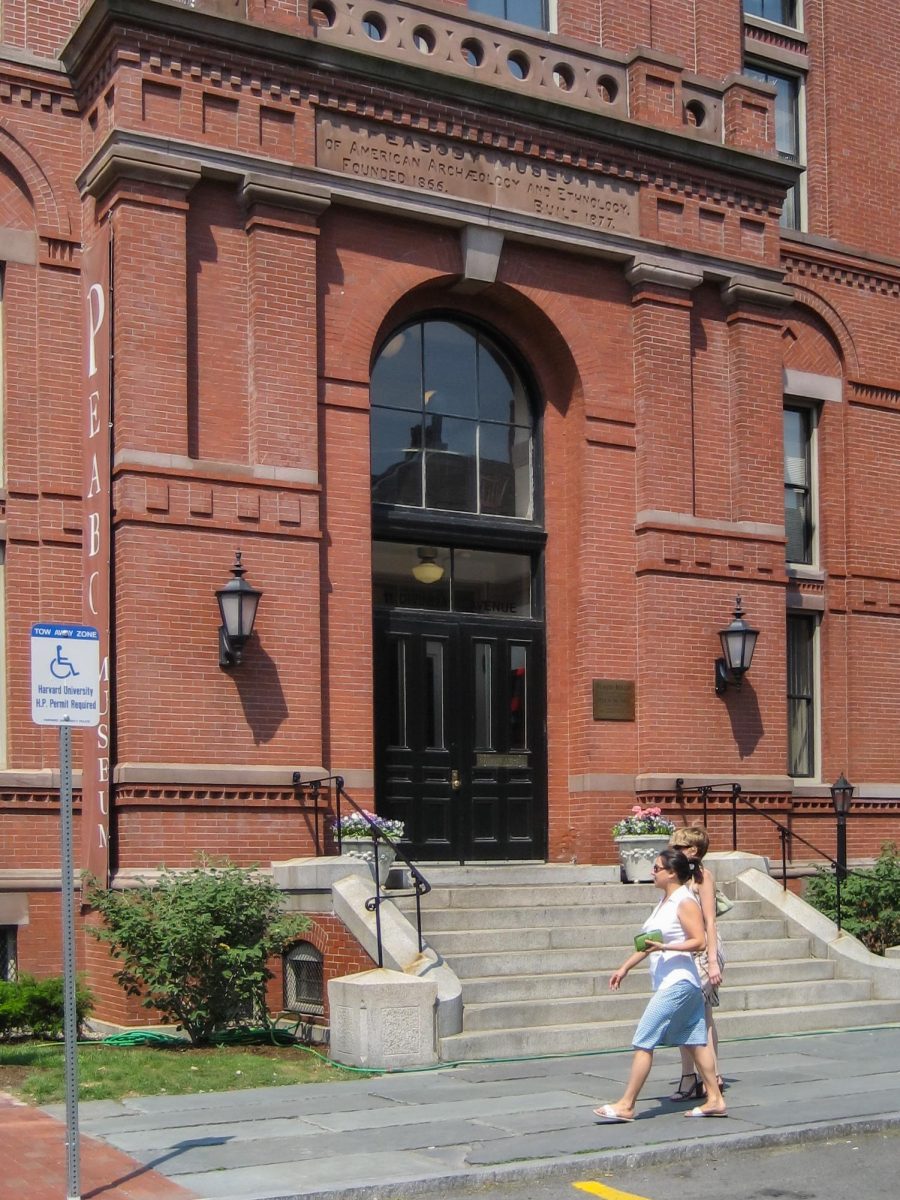
The Peabody Museum of Archaeology and Ethnology at Harvard University is hosting an exhibit by art collective TRES entitled “Castaway: The Afterlife of Plastic” until April 6, 2026.
The members of TRES, Ilana Boltvinik and Rodrigo Viñas, are based in the Mexican city of Xalapa but spent much of their lives in Mexico City, where the collective was founded. Their work focuses on garbage as it relates to current environmental, social and political concerns. “Castaway” is one of many projects TRES has produced exploring what happens with an abundance of built-up waste as large as humanity’s.
“Castaway” is part of a 2016 project titled “Ubiquitous Trash.” It features images of debris on Australian beaches. The first part of “Ubiquitous Trash” was featured in various galleries in Hong Kong, drawing attention to the proportion of municipal solid waste that goes into their landfills — upwards of 60%.
The Peabody Museum awarded TRES the Robert Gardner Fellowship in Photography in 2016, which grants an opportunity to publish a book of photographs through the museum and, in some cases, feature the photographs in the museum itself. Curator Ilisa Barbash said that “Castaway” was chosen in part because “people’s trash and its disposal said a lot about the human condition.”
According to Barbash, every artist or collective awarded the Gardner Fellowship has produced topical art. With art projects that focus on environmental issues or topical concerns in general, it’s often inferred that the project is meant to raise awareness. The Peabody Museum is connected to the Harvard Museum of Natural History, which has a concurrent exhibition on climate change.
However, raising awareness isn’t necessarily the point of “Castaway.” “We’re overwhelmed with awareness,” Boltvinik said. The issue is complex, she added, with many now desensitized to images of environmental destruction.
Margaret Hart, photography professor at UMass Boston, has an interest in environment-focused photography herself and was aware of TRES’ work before the opening of “Castaway.” Hart was one of the organizers of the “Thinking About Climate Change: Art, Science, and Imagination in the 21st Century” conference which UMass Boston hosted in October 2024. The conference featured panels with academics and government workers from disciplines including biology, visual art, anthropology and civic affairs. Hart hopes that the conference will be held every few years. She also highlighted attempts on the part of UMass Boston art faculty to use more sustainable methods in producing art, including the use of paints whose disposal won’t be as damaging to the environment, and a silver reclamation system for fixer used to develop photographs.
Noble as these attempts may be, Boltvinik acknowledged that a total dissection of waste produced as a result of photography is almost impossible. “It’s very exhausting to trace everything you use and discard,” she said.
Viñas agreed, stating that the tracing of wasteful material involved in photography, be it digital or analog, “can make you depressed.”
TRES sees their projects as part of a larger effort to focus on, or even promote, social justice. According to Boltvinik, TRES’ projects are explicitly political in nature. Growing up in Mexico City, she said, “Garbage was everywhere — but nobody noticed it.” TRES’ interest in garbage, according to her, stems in part from a desire she and Viñas have to “see, talk and listen to those that are usually not seen, talked to or listened to.” By way of example, she mentions street sweepers in Mexico City. The work is difficult, but because of the association with garbage, these workers are, in her view, cast aside. They are, in a sense, themselves residuals.
The question of how exactly one makes something like garbage into visually appealing art, assuming that’s what an artist wants, is vexing. Hart cites artists such as Chris Jordan and Edward Burtynsky as examples of people who have made images of destruction and even death visually appealing. Jordan’s work often features pictures of birds who died after ingesting plastics and artificial materials. Though horrifying, the images can be quite colorful. Plastic sometimes is. Burtynsky’s work features images of environmentally degraded landscapes that are visually striking and, according to Hart, beautiful, even if they are disturbing.
TRES, however, sees the spread and disposal of garbage as “an endless fountain of information,” according to Boltvinik. Viñas characterized some of the ecosystems he and Boltvinik explored in Australia as pristine environments full of “terrible things,” including stray bottle caps, plastic bottles and cans — all disposed of as litter on the ground rather than as recyclable waste.
Though TRES documents alarming trends in environmental change, they remain driven by curiosity as much as anything else. According to them, there is still much to photograph, some of it as amazing as it is disturbing.
“We don’t know where we live,” Viñas said. According to him, there are any number of details in our immediate surroundings most people just don’t pick up on. One may not think of garbage as beautiful, per se, but that’s where TRES challenges their audience. “Castaway,” according to Viñas, is intended to explore the contrast between the beautiful and the disgusting.
Boltvinik, for her part, considers the contents of “Castaway” to be “an overwhelming, beautiful surprise.” “Castaway” explores “what we think plastic is, and what it really is,” she said. Whatever the implications for the environment might be, she does not consider the ubiquitous presence of garbage “a horror.”
“It’s a toxic environment,” Hart said in reference to images displayed in work like TRES’, Jordan’s and Burtynsky’s, “but it’s still beautiful.”