
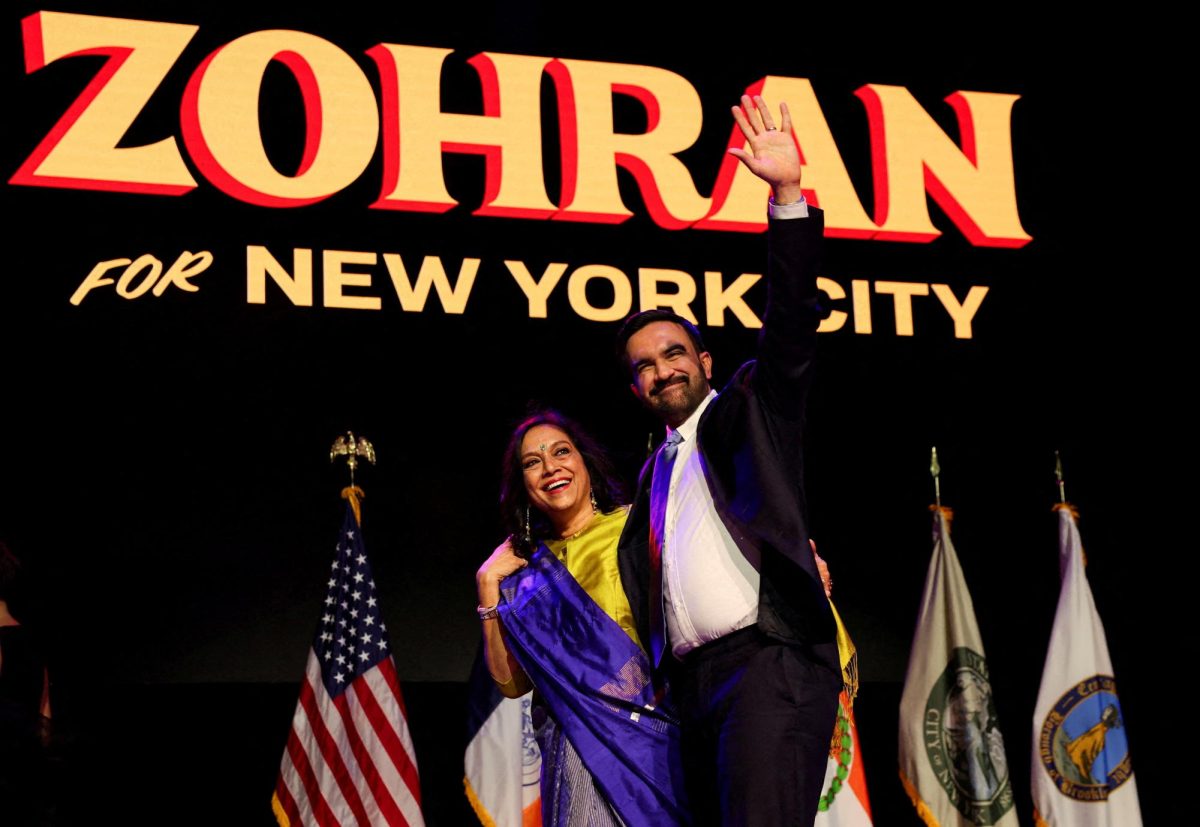
In a historic victory, Zohran Mamdani handily defeated former New York Gov. Andrew Cuomo and Republican candidate Curtis Sliwa in the Nov. 4 New York City mayoral race, becoming the first Democratic socialist and the first Muslim to be elected mayor of New York City. Just how did he inspire one million New Yorkers to get out and vote — the largest turnout in over half a century — and what can the Democratic Party learn from his success?
The core of Mamdani’s campaign focused on affordability. Instead of exploiting the cost of living crisis that plagues so many Americans without offering tangible solutions, as President Donald Trump did in the 2024 presidential election, Mamdani has proposed concrete policies he plans to implement once sworn into office.
These policies include freezing rent for more than two million tenants, providing universal childcare and free city buses for all New Yorkers and opening government-subsidized grocery stores to compete with privately owned companies. These goals, while ambitious, provide a framework for a vision of New York City’s future — something largely absent in the campaigns of contemporary Democrats.
Mamdani also embraced a populist style of politics to catapult himself to victory. With the enlisted help of over 50,000 volunteers, Mamdani’s campaign was able to knock on the doors of 1.6 million New Yorkers. His team also took to social media, shooting dozens of videos and gaining millions of views, which allowed his message to reach the younger generations online. Embracing the phenomenon of social media is a tool in modern American politics that most candidates have yet to effectively utilize. Mamdani is only the latest example, with others, such as Graham Platner of Maine, following in his wake.
Mamdani appears to be the product of a strain of politics mostly personified by Vermont Senator Bernie Sanders and New York Representative Alexandria Ocasio-Cortez. From them appearing as guest speakers at Mamdani’s rallies to a video dialogue he did with Bernie, it’s clear that Mamdani has embraced their populist, economic-focused strategy and made it his own.
As the 2028 presidential election looms on the horizon, the Democratic Party needs to take note of Mamdani’s success and allow for some substantial self-reflection. In times when the majority of voters are unhappy about the economic status of our country, a candidate like Mamdani, who promises change, is more inspirational than a candidate who would maintain a destitute normalcy.
A large portion of Donald Trump’s success in his two winning presidential bids came from threatening to disrupt the status quo. His platform — which preyed on suffering Americans, promising them reprieve — ignited a nationwide movement. Yet many promises remain unfulfilled from Democrats and Republicans alike through the years, breeding resentment and distrust among voters.
Mamdani has also taken a firm stance against Trump’s recent authoritarian power-grabs in deploying the National Guard to cities like Portland, Chicago, Washington, D.C. and Memphis. Mamdani has said he will refuse to cooperate with the National Guard.
While Trump’s crackdown on immigration rages through cities like Los Angeles and our very own Boston, Mamdani has decried I.C.E. and insisted on New York City’s status as a sanctuary city. He also remained staunchly pro-immigration, declaring that New York City was “built by immigrants, powered by immigrants and, as of tonight, led by an immigrant,” during his victory speech.
The question is: can Mamdani truly deliver on his promises? He plans to raise taxes on New York City’s wealthiest few by 2% and raise the corporate tax rate to that of New Jersey’s, from 7.25% to 11.5%. With this, he plans to raise billions in revenue to pursue his policy changes.
Only time will tell if he can truly deliver positive change to New York City. But regardless, his campaign’s progressive messaging created a ripple of hope in a time when immigrants are being kidnapped, public education defunded and healthcare stripped from millions. All we can do is wait and see how far that ripple can take us.