
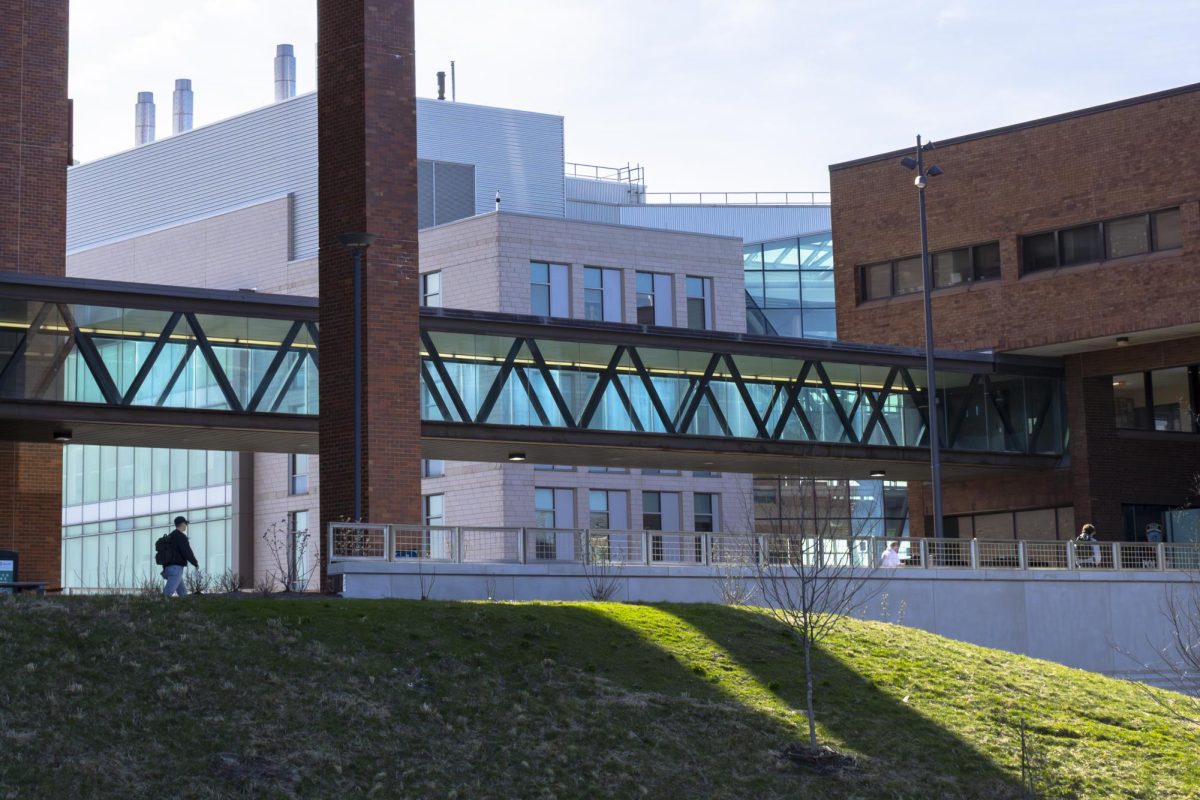
There are many joyful things about winter, from warm marshmallows melting into hot chocolate to snowflakes falling on a glowing Christmas tree. But walking through the quad while the cold harbor wind shoves you off course? Not on the nice list.
Housing more than half of the general education classes, Wheatley Peters Hall and McCormack Hall are among the most frequently visited buildings at UMass Boston. Each school day, hundreds of students have to bounce between the two buildings to get to classes — which makes an easy, accessible connection between them essential.
However, McCormack, despite being at the heart of academic life, stands completely on its own, whereas its neighbor, Wheatley Peters, stretches an enclosed airway to the second floor of the Campus Center. Though unassuming, that walkway creates a seamless transition between academic and campus life.
Going to your 2 p.m. class after saying goodbye to your club mates? Easy. Grabbing lunch at the Dining Commons after a physics class in Wheatley Peters? Five minutes.
I dream that one day the same could be said about McCormack. Though honestly, Wheatley Peters and McCormack are already so close that connecting them can feel unnecessary — at least I believed that right up until I stepped out of McCormack’s front entrance. Immediately, I got launched five meters off my trail by the New England winds.
After enough trips like that, it’s hard not to imagine a perfect world where walking through the quad doesn’t feel like crossing an arctic tunnel. A world where students can grab a coffee in between class breaks without getting blown away. A world where our compact campus finally becomes truly connected and accessible.
Digging deeper, I learned that our campus used to be more connected than it is today. Beneath McCormack and Wheatley Peters lays what remains of an underground parking lot which once included a path connecting the two buildings and allowing students to traverse effortlessly.
The Quad — the green heart of the campus — was once the site of a science building which connected to Campus Center and McCormack through elevated walkways, completing the link between the four buildings. When time came to build a new science building, the Integrated Sciences Complex was built hundreds of feet away instead, creating a major academic hub that now sits awkwardly detached from the rest of campus.
While the bus provides a convenient route, its inconsistent schedule makes it difficult to arrive on time to classes — whereas walking remains the greener and often far more dependable choice.
Though the purpose behind the redesign remains unclear, the consequences of a disjointed campus extend far beyond mere inconvenience — affecting how we move, where we study and which resources we end up using.
While Dunkin’ in the Campus Center is always packed during peak hours, the Recreo Coffee at the ISC is lucky to see more than five people in line at once. And while the Student Success Center in Wheatley Peters receives a steady influx of students each week, the Center for Academic Excellence on the eighth floor of the Healey Library remains largely overlooked for its obscure placement.
Has anyone besides nursing and exercise and health sciences students ever visited the study space on the lower level of the Quinn Administration Building? And when was the last time you went to the Clark Athletic Center, compared to how often you stop by the Beacon Fitness Center?
Instead of feeling like a home, our campus often feels more like an apartment where tenants occupy whichever room happens to open next, with little regard for whether students can reach them comfortably or efficiently.
At a campus like UMass Boston, where the longest walk — between the ISC and University Hall — takes just under fifteen minutes, commute time is rarely the true dealbreaker. What’s frustrating is the number of missed opportunities to make our campus truly accessible and connected, especially considering how closely the buildings sit to one another.
Secluded buildings and difficult walkways lead to underused resources and neglected spaces. At a largely commuter school, the first impression often isn’t that the campus is a resource in its own right, but that Boston is the place students turn to instead. Without changes to these planning shortfalls, that perception will remain.
And the consequences? As small as a couple minutes lost, and as big as a campus community that never gets the chance to form.