
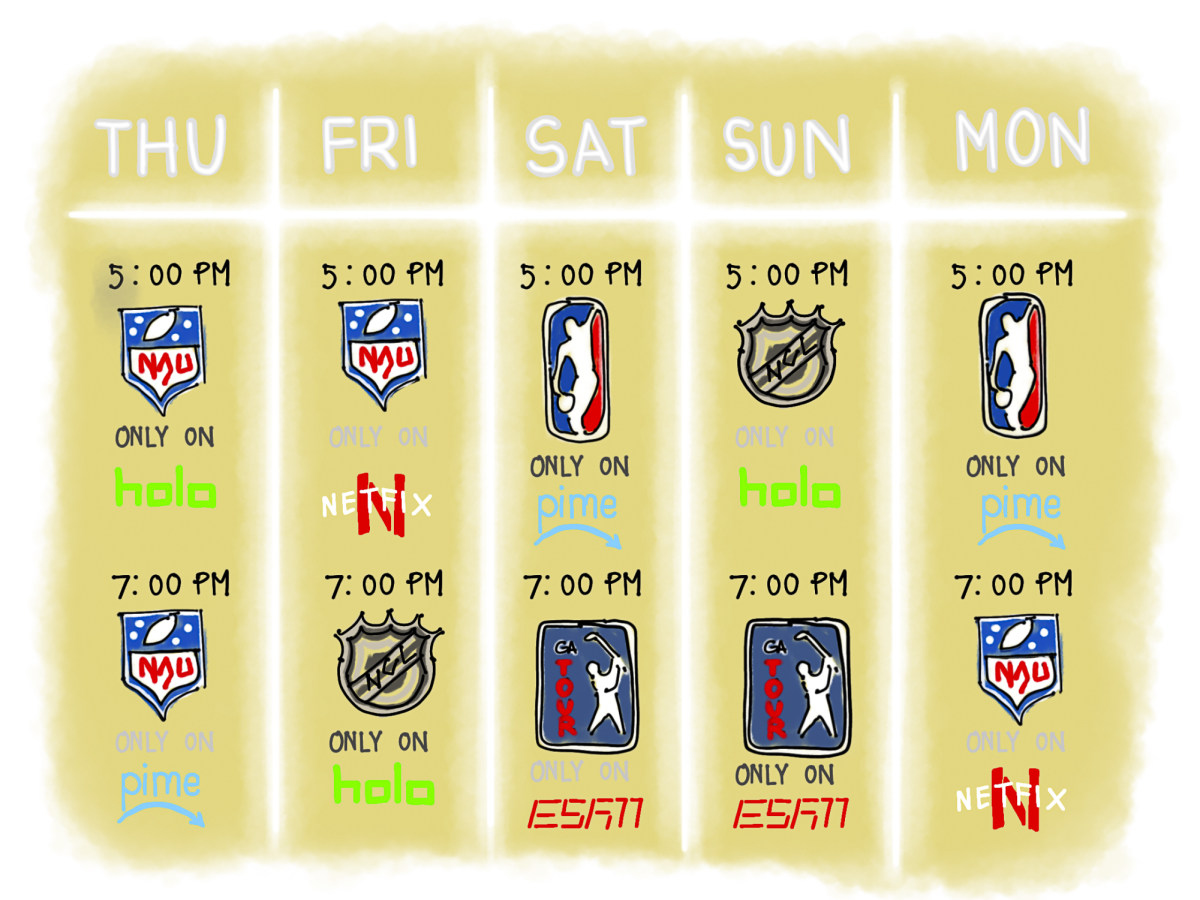
Personally, I have never been all that into movies or TV shows. My friends and family often make fun of me for never having watched “Friends” or many of the so-called “classic” films, but my preferred source of entertainment has always been sports.
Being an avid sports fan is a year-round commitment, constantly bouncing from basketball season to football to hockey, just to stay up to date. However, it has never been more difficult to be a sports fan than in 2025, with live sports now scattered across numerous streaming platforms.
It feels as though every night of the week, certain games are streaming on a different platform. Take the NFL for example.
Want to watch Monday Night Football? That’s only on ESPN or ESPN+. The Thursday night game? Amazon Prime. Maybe on Sunday you can catch the game you want — but for any diehard that wants to follow everything, they will need to purchase NFL RedZone from NFL Network.
Figuring out how to watch your favorite team or the game of the night has become quite the nuisance for all fans. Not only is it frustrating to bounce from one platform to the next just to find the broadcast, but it is also becoming incredibly expensive.
The cost of streaming services continues to rise, as U.S. consumers are spending an average of $22 more on streaming than in 2024, with those broadcasting live sports games being no exception. An August study from Performance Research and Full Circle Research found that 68% of sports fans reported concerns with the cost of streaming sports, with 73% claiming they are “looking to reduce streaming expenses in the next six months.”
Simply being a fan has become unreasonably expensive. Leagues now expect fans to spend an outrageous amount just to follow their favorite teams and players — and even then, access is never guaranteed.
Blackouts are a major issue for fans relying on streaming services. These restrictions block viewership in certain regions to protect exclusive broadcast rights for networks.
In my experience as a devoted Boston Celtics fan, NBA League Pass’ blackout restrictions are my chief adversary.
The standard NBA League Pass subscription costs $16.99 per month, providing access to every live NBA game that night. In theory, it’s a basketball fan’s dream. However, the caveat is you cannot watch games in your region due to the league’s blackout policies.
For me, that means the NBA’s main streaming service keeps me from watching my favorite team. In order to watch the Celtics, I have to pivot to an alternative: a $82.99 monthly YouTube TV subscription. Doing the math, it ends up costing me nearly $99.98 per month just to be a basketball fan.
A streaming service would feel worthwhile if it offered fans complete and reliable access, but without that guarantee, even the most passionate fans are left navigating a system that feels increasingly unaffordable and unreasonable. By embracing the trend toward streaming dominance, professional sports leagues are further complicating the modern fan experience and turning the fandom into more of an inconvenience.

