
“Use it or lose it.”
As the old saying reminds us, we must stay physically active to remain healthy and strong. But when it comes to the brain, why do we let automated intelligence do the most important exercise: thinking?
“You wouldn’t bring a forklift into the gym,” said UMass Boston computer science professor Amanda Potasznik. “It defeats the whole point of bodybuilding.”
The same principle applies to the brain.
Our brains create new neural pathways or strengthen existing ones whenever we process new information or act with intention. The more we use our brains, the better they perform when faced with complex tasks and responsibilities.
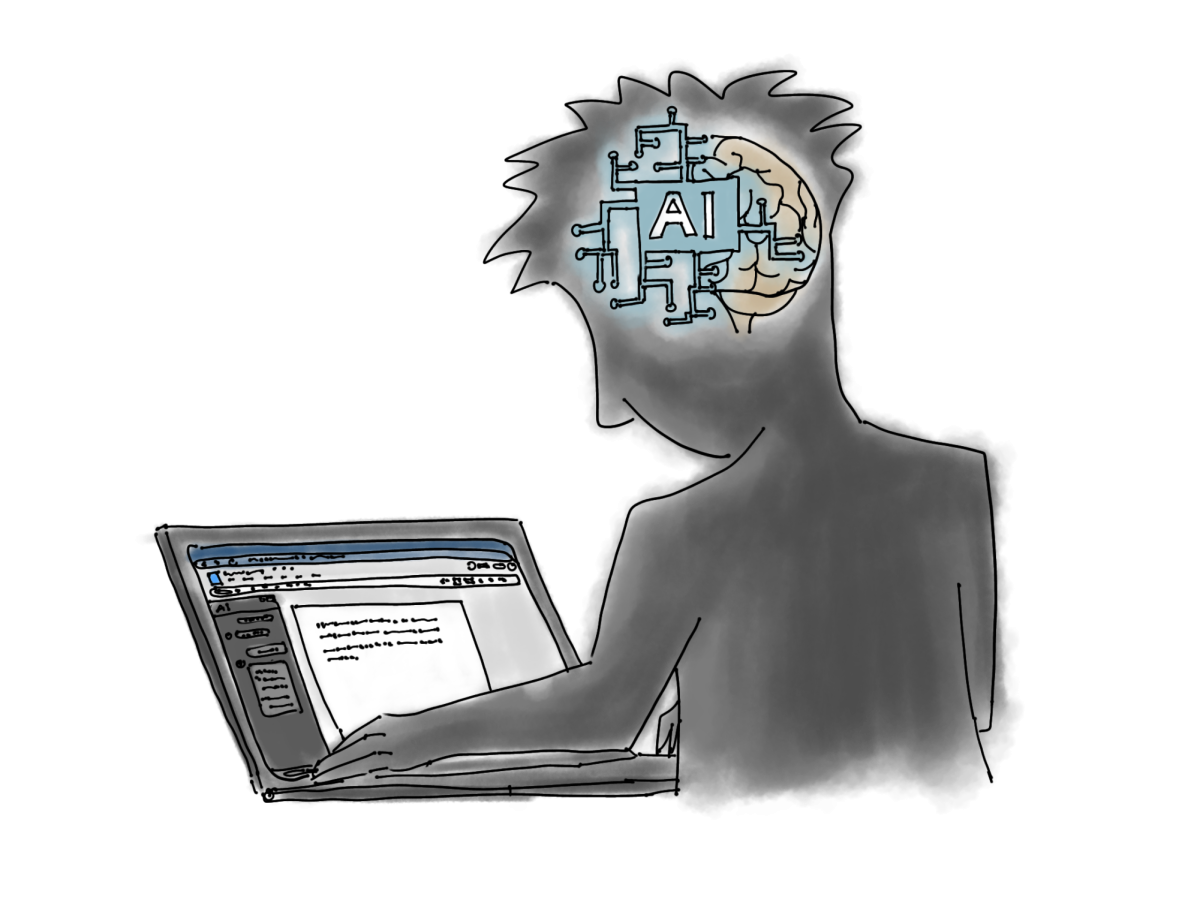
Yet, recent research suggests the logic may work in reverse. In the first-ever brain-scan study of humans using ChatGPT, Nataliya Kosmyna and her MIT Media Lab team found that handing over mentally demanding tasks to AI may contribute to cognitive atrophy — the gradual weakening of neural pathways due to prolonged disuse.
To examine AI’s effect on human brains, researchers divided participants into three groups to complete the same English essay prompts: one used ChatGPT, one used a search engine, and a control group that used no external tools. Notably, the ChatGPT-only group showed the lowest neural engagement, and 83% were unable to recall specific sentences from their essays just minutes after writing them.
The evidence leaves no room for debate: the question is no longer whether we should use AI, but how much control over our own minds we are willing to relinquish.
To understand the significance of this study in a classroom context, UMass Boston computer science professor and senior lecturer Amanda Potasznik, who teaches CS 285L, Social Issues and Ethics in Computing, offers insight on the emergence of AI from a teacher’s perspective.
When asked how UMass Boston is implementing AI policies on campus, Dr. Potasznik said the university offers instructors two solutions: “a blanket ban, or ‘ethical’ use.”
As an AI ethics researcher, she described the university’s ethical-use guidelines as still developing “as they are currently articulated,” but acknowledges the freedom faculty has to modify the details to fit their teaching styles.
For younger generations who grew up with technology, the defense for using AI is crystal clear. Outsourcing dull, tedious tasks — such as summarizing an article — frees up mental energy for the more rewarding parts of the learning process, where human creativity can flourish.
However, Dr. Potasznik warns students that this easy convenience comes at a hidden cost.
“We become who we are, and know what we know, because we make certain cognitive demands on our neural pathways,” she argues. “Outsourcing any thought process, from menial chore to creative essay, to a generative AI product is going to contribute to cognitive atrophy.”
Whether we are aware of it or not, the human brain prioritizes efficiency by design. The creation of search engines, for instance, has become an external extension of our memory. This tendency to forget information that can be easily retrieved online is widely known as the “Google Effect.”
Now, with the invention of AI, it is not a reach to say that over-reliance of ChatGPT is outsourcing the functions and utilities of our frontal lobes.
Dr. Potasznik says that it ultimately boils down to one question: “What am I okay with not being able to do?”
Where classrooms should draw the line on technology use has been debated since the birth of the internet. While the ability to access a vast sea of knowledge in just a few clicks is unmistakably valuable, educators and students must clearly distinguish between technologies that support learning and those that diminish the learning process itself.
Even if learning requires struggle and mistakes, human agency over our own minds should never be compromised by using automated intelligence.
