
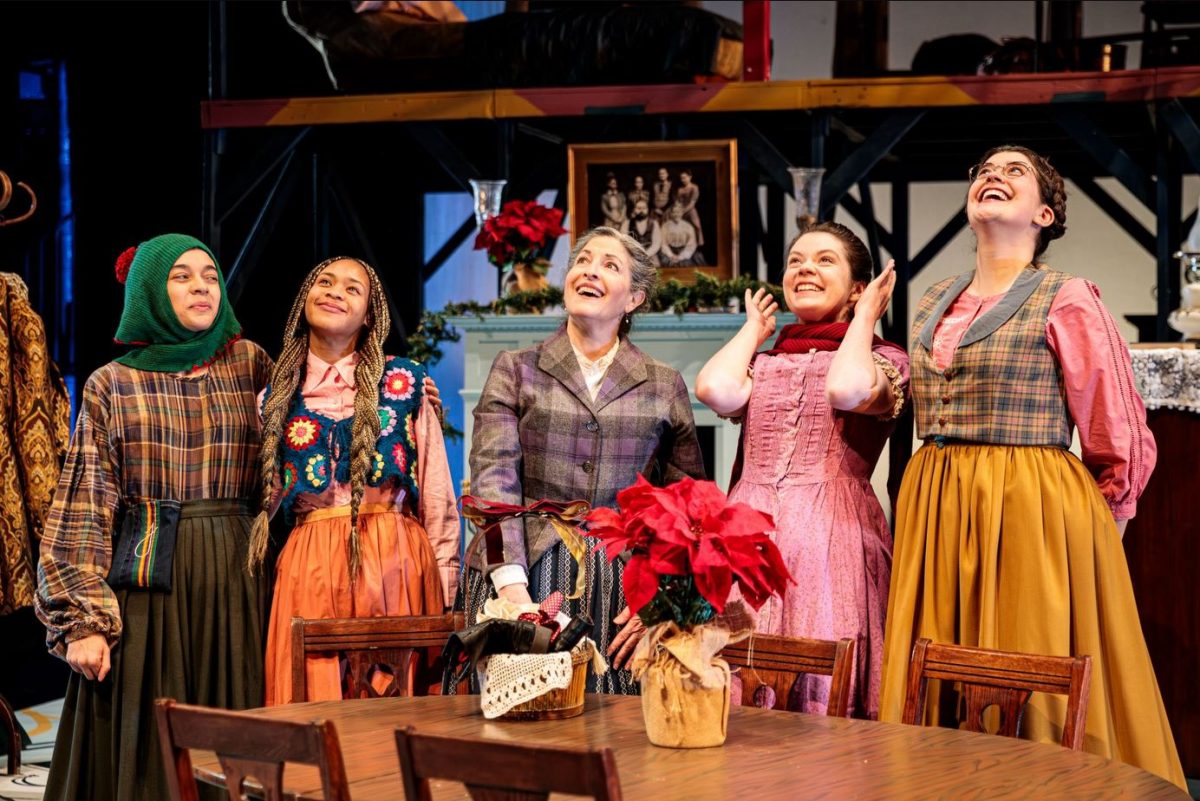
A stage performance of “Little Women,” directed by Shana Gozansky, is showing at the Dorothy and Charles Mosesian Center for the Arts until March 1.
The play, based on the novel by Louisa May Alcott, was adapted by Kate Hamill and is performed by the Actors’ Shakespeare Project. With a cast of only nine actors, the production feels intimate, drawing the audience into the March family’s living room and into the tensions of growing up, ambition and gender expectations.
With such an iconic novel, it would be easy to feel pressure to keep the story frozen in time. Gozansky emphasized her desire to honor the original text while also bringing forward questions that resonate with audiences today.
“We wanted to make this a more explicit story of how gender functions in a contemporary adaptation while still being respectful of the original,” Gozanksy said.
Throughout both the novel and play, Jo March struggles with the expectations placed on her as a young woman. In Alcott’s book, Jo rejects traditional femininity. She cuts her hair, speaks her mind and dreams of becoming a famous writer rather than a wife or mother. Although the novel acknowledges her discomfort with the roles available to women, it ultimately ends with Jo marrying a professor.
Hamill’s adaptation pushes that tension further. In this version, Jo’s resistance to conventional womanhood is more directly articulated. Played by nonbinary actor Aislinn Brophy, Jo tells Marmee she will never be a lady like her sisters. She confides in Laurie that she sometimes wishes she were a boy. The performance balances Jo’s wit and confidence with an undercurrent of fear that the life she wants to live may not be possible.
The choice to cast a nonbinary actor in the role adds another layer to the production. Rather than presenting Jo’s frustrations as a passing phase, the play treats them as central to her identity. Moments that might feel lighthearted in other adaptations take on added weight, especially in scenes where Jo is confronted with marriage as an inevitability.
There has been ongoing conversation on Alcott’s own relationship with gender. In letters and journals, she described herself as having a masculine soul or spirit, and was described as “wild and queer” by her peers growing up, often rejecting the constraints placed on women in the 19th century. Some scholars and readers have speculated about how those feelings shaped her writing. Many see Jo as Alcott’s closest self-portrait, a character who channels the author’s ambition and resistance.
The story is often framed as a coming-of-age tale about sisterhood and domestic life. This production shifts the focus to gender, treating Jo’s discomfort with traditional womanhood as central rather than incidental. By doing so, the adaptation confirms that genderqueer identities have long existed in classic literature, even if they were never named outright. Jo’s struggle becomes not just about ambition, but about defining herself in a world determined to define her first.
The intimacy of the staging reinforces that focus. The entire production unfolds on a single set that transforms to suggest different locations. The central structure represents the March home, complete with two levels that allow for layered staging and overlapping conversations. A secondary set piece shifts to become Laurie’s house, the ballroom and Aunt March’s residence.
The design team drew inspiration from Civil War-era wallpaper patterns for the floors, grounding the play in its historical setting. At the same time, the fluid movement between spaces keeps the pacing brisk. Actors rearrange furniture and props in full view of the audience, underscoring the theatricality of the adaptation rather than attempting strict realism.
Because the cast is small, some actors take on multiple roles. This choice emphasizes the interconnectedness of the characters’ lives and keeps the focus on the emotional core of the story. Scenes of domestic warmth, such as the sisters reading or performing plays together, contrast sharply with moments of loss and disappointment.
When asked what she would say to Alcott, Gozanksy did not hesitate. “I would just say ‘you did it. You wrote something so unbelievably enduring that it’s lasted generations and means so much to the people who grew up with the story,’” she said.
That sense of endurance is palpable throughout the performance. Even for audience members who know the plot by heart, the production offers new questions to consider. What does it mean to live honestly? Who gets to define a happy ending? And how much of ourselves are we willing to reshape to fit the expectations around us?
By leaning into those questions, this staging of “Little Women” feels less like a museum piece and more like a conversation — one that continues long after the curtain falls.

