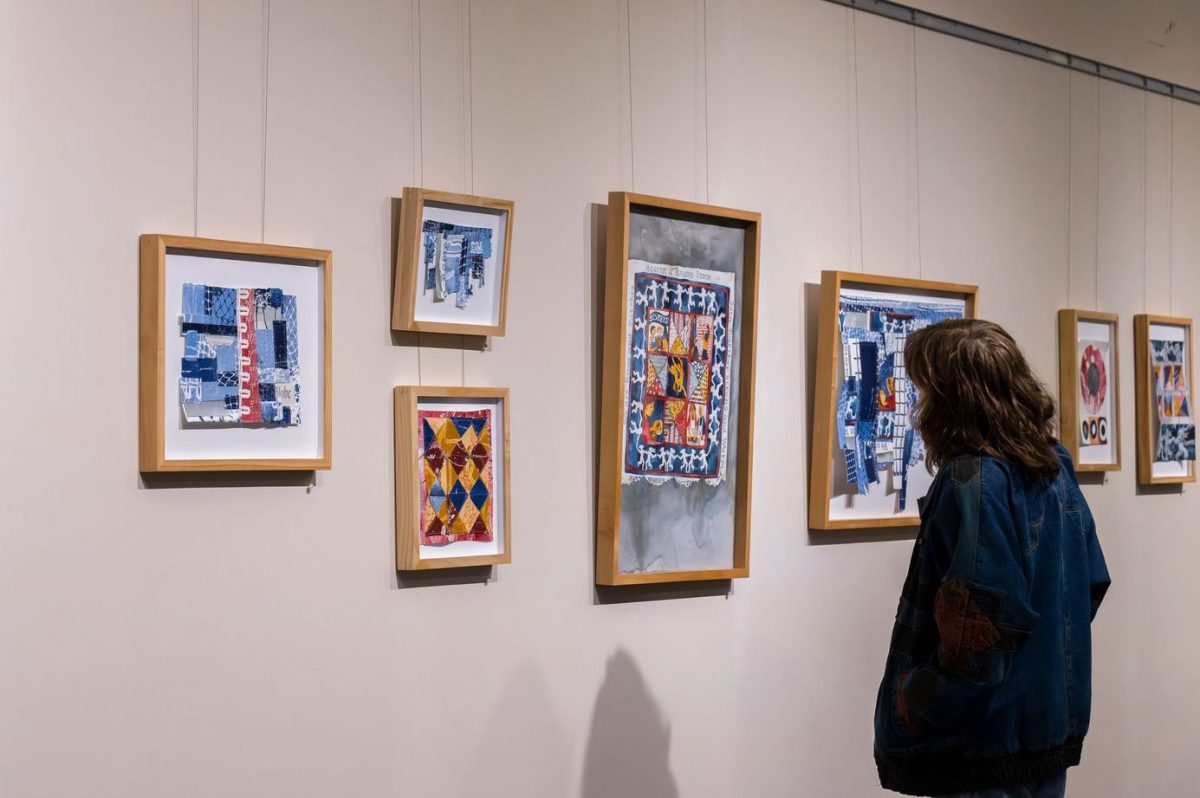
The Grossman Gallery on the fifth floor of Healey Library is showing a mixed media exhibit exploring seven of the library’s archives until May 15.
Five artists were selected for the exhibit, entitled “Material Dialogues: Artist Unresidency,” through a jury process by curators Meghan Bailey, Carol Scollans and Jeremy Andreatta. The artists are from a group called Art+Everywhere, a collaborative whose membership consists of MFA graduates from different art schools.
Artist Brooke Toczylowski focused on the Boston School Bus Drivers Union records, the Elizabeth Bouvier collection of radical and leftist posters and the Stephen Lewis poster collection. Toczylowski works in different artistic mediums, one being printmaking, and has experience designing posters herself. She felt drawn to the posters in the collections, both for their artistic merit and their political messaging.
She mentioned one poster by an unknown artist, attributed to a group called the Boston Women’s Graphics Collective, that shows a patchwork of patterns and depictions of women engaged in different activities, including painting the word “STRIKE” on a brick wall. Around the edges is a message reading, “We are rags and patches against a raging storm. Join together strong and warm.”
“I wasn’t expecting to see this sense of hope,” Toczylowski said. “I realized we really need it in this moment.”
Other artists in the exhibition include Caleb Cole, Nancy Hart, Christina Hunt Wood and Brian Wilson. Once the artists were selected, Bailey took a hands-off approach to the work the artists contributed. “I didn’t want to direct the artists. I wanted to give them space to explore in the way that they wanted. I think the more control you have over it, it’s probably not going to be as dynamic,” she said.
Toczylowski was particularly impressed by the Bus Drivers Union material. The union grew out of labor organizing in the 1970s that sought to push back against racism in the wake of compulsory busing meant to desegregate schools in Boston. She said the union’s archives address a surprisingly broad array of social and political issues, including housing, childcare and gender rights.
“I was just completely floored with the amount that was in that collection,” she said. “I wanted to honor that work.”
While on sabbatical from her job at UMass Boston’s archives, Bailey researched how archives could serve as fodder for an artist’s work, or even an exhibition. The archives were used primarily by students working on academic projects, faculty members, journalists and genealogists before the exhibit’s planning, she said. Bailey, who has worked in the archives for 11 years, wanted to find new purpose for them. She also felt the Grossmann Gallery was underutilized.
“Part of our goal around this is to activate more collections, ones that aren’t always being utilized, and bring them to light,” she said.
According to Bailey, who has hosted events at the gallery before, students are more engaged with this exhibit than previous ones. She sees them looking at this collection more often than she did with previous ones, and has gotten positive feedback from other employees at the library.
Said Bailey, “I’ve had some of the library staff go through the exhibit and tell me they’re very excited about it and very interested in the work there.”