
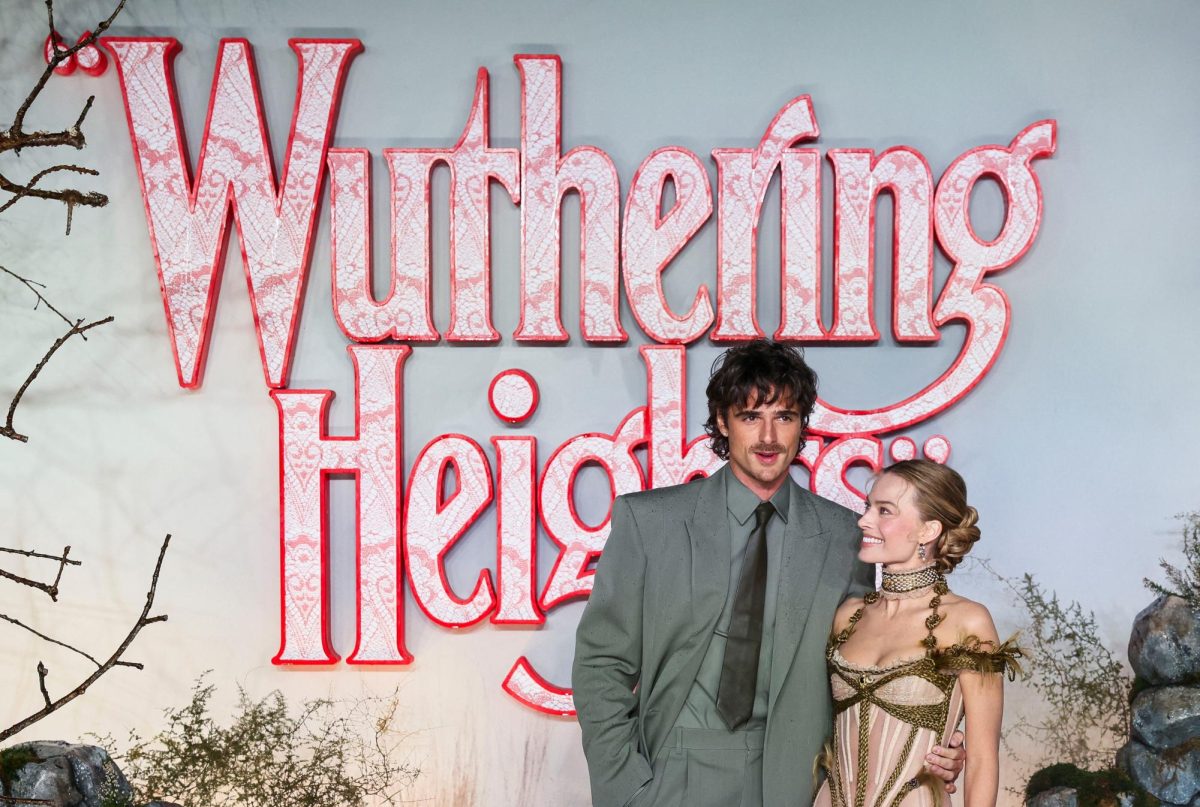
Emerald Fennell’s adaptation of Emily Brontë’s classic novel “Wuthering Heights” was released on Valentine’s Day and has caused a heated internet divide months before it hit theaters.
When the cast list was announced last year, immediate criticism surfaced online due to the casting of Jacob Elordi, a white actor, as Heathcliff — a character described in the novel as a man of non-white heritage. That detail is not incidental. Heathcliff’s racial ambiguity and outsider status shape the novel’s social tensions and power dynamics. His relationship with Catherine Earnshaw is doomed not only by pride and cruelty, but by the rigid class hierarchy and racial othering that define their world.
Fennell’s film strips down much of that necessary conversation on the intersection of race and class. In the novel, Heathcliff’s marginalization fuels his anger and ambition. It explains, though never excuses, his eventual brutality. In this adaptation, those tensions are flattened to center a toxic and ill-fated romance. What remains is aesthetic longing without the structural critique that made the original text so radical.
The marketing describes the film as “inspired by the greatest love story,” but is it even a love story at all?
To name this story a romance feels like a mislabeling, given the horror and violence embedded in the source material. When Brontë first published “Wuthering Heights” in 1847 under the pseudonym Ellis Bell, early reviews described the novel as “disagreeable” and immoral. Readers were unsettled by its cruelty, its lack of tidy redemption and its refusal to reward virtue. The novel has endured not because it is romantic in the conventional sense, but because it is honest about obsession, revenge and generational trauma.
Supporters of the film have taken to social media with posts like “here come the English majors to ruin the movie.” But thoughtful criticism is not the same as nitpicking. No one expects a literary adaptation to mirror its source material scene for scene. Still, when the original text is this dense and politically charged, especially in the current climate, it feels careless to sidestep its themes of racism, class hierarchy and abuse in favor of a more palatable romance.
Fennell has described her adaptation as the story she remembers reading at 14 years old. Through the lens of a hopeless romantic teenager, the forbidden love between Catherine and Heathcliff might feel sweeping and tragic. But reshaping the novel around that singular interpretation narrows its scope. By foregrounding eroticism and longing over social commentary, the film reduces a complex, multi-generational narrative to a moody relationship drama.
That reduction is most apparent in the erasure of the novel’s second generation. In Brontë’s text, the children of Wuthering Heights and Thrushcross Grange inherit the sins of their parents, only to tentatively break the cycle. The younger Catherine, Hareton and Linton are not narrative afterthoughts. They are essential to the novel’s argument that cruelty is learned, and that healing is possible, however fragile. Without them, the story ends in pure devastation, stripped of its uneasy hope.
Isabella Linton’s storyline is similarly diminished. In the novel, Isabella’s marriage to Heathcliff exposes the stark realities of domestic abuse and the limited options available to women trapped by social expectations. Her letters offer one of the clearest perspectives on Heathcliff’s manipulation and violence.
In Fennell’s adaptation, Isabella is not only sidelined but humiliated. At one point, she is reduced to crawling across the floor and panting at Heathcliff’s feet, a choice that renders her less a fully realized character and more a spectacle of submission. Rather than deepening the film’s critique of gendered power, these scenes flatten Isabella into a caricature, stripping her of the agency and narrative weight she carries in the novel.
None of this is to say the film lacks merit. Visually, it is striking. The Yorkshire moors are rendered in windswept frames that capture both beauty and isolation. The production design is lush without feeling overly polished, and several performances carry genuine emotional weight.
On its own, the film might stand as a moody and visually arresting gothic romance. Its heightened emotions, bold costume choices and stylized performances suggest a director with a clear aesthetic vision. But attaching the name “Wuthering Heights” invites comparison to one of the most layered and politically charged novels in the English language. With that title comes an expectation of thematic depth and fidelity to the novel’s core tensions. Had the film been released under a different name, it might have been received as a creative original screenplay rather than a diminished adaptation weighed down by what it chooses to leave behind.
Ultimately, this adaptation raises a larger question about what we owe to classic texts when we revisit them. Reimagining canons is not the problem. In many ways, it keeps literature alive, but reinterpretation requires careful intention. When a story as culturally and politically loaded as “Wuthering Heights” is softened into aesthetic tragedy, something essential is lost. What remains is a film that is easy to watch, understand and market, but far more difficult to defend as a meaningful engagement with the novel it claims to honor.
