
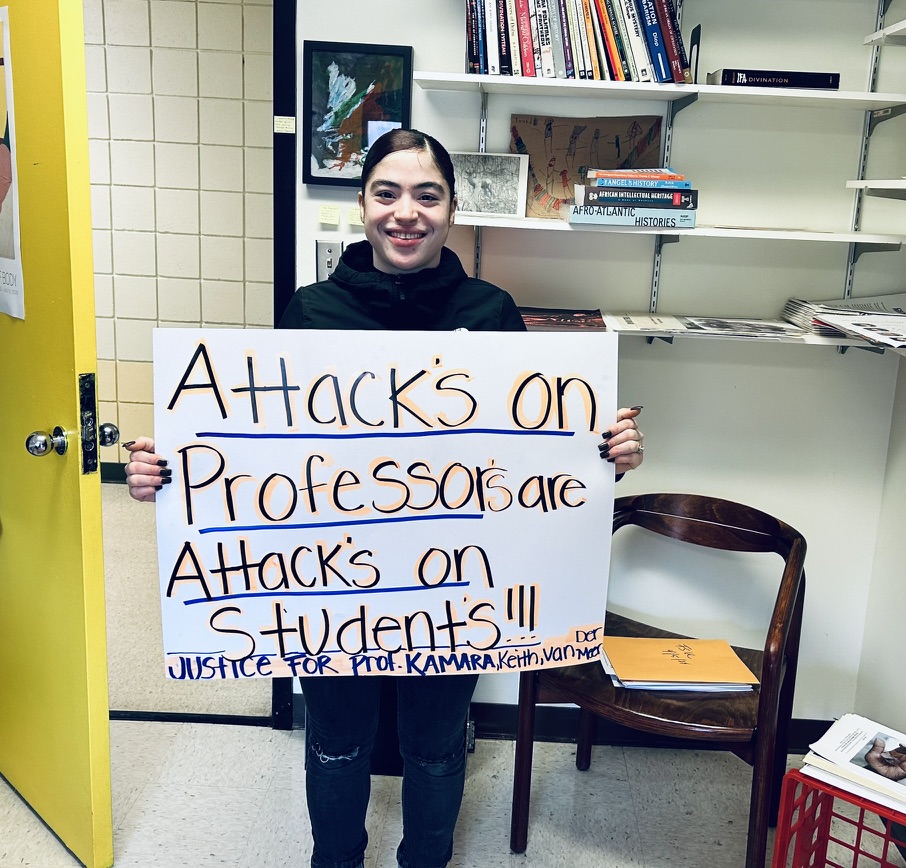
I write this not only as a graduate of UMass Boston, but as someone whose life was fundamentally shaped by the leadership of professor Keith Jones, professor Tony Van Der Meer, and professor Jemadari Kamara of the Africana studies department. These three professors were not only educators during my undergraduate journey; they were transformational forces in my life.
I began my undergraduate journey in 2017 and graduated in 2022 with a degree in psychology, a minor in Africana studies, and a concentration in communication. For many of us, half of those years were marked by extraordinary challenge, a global pandemic and a racial reckoning that deeply impacted Black communities across this nation. During that time, the Africana studies department became more than an academic space. It became a sanctuary, an intellectual home, and a source of grounding during an incredibly fragile period for many Black students, myself included.
As a young Black student entering the realities of today’s world, I enrolled in my first Africana studies course during my freshman year seeking to better understand my identity, my history and my place in the world. I arrived at the university curious but searching. During that time, Jones, Van Der Meer and Kamara demonstrated a level of leadership, brilliance, integrity and intentional care that was integral not only to my academic success, but to my personal evolution.
These professors, who continue to serve as pillars of this department, did not simply teach content. They cultivated leaders. They validated lived experiences. They challenged us to think critically while holding space for the emotional realities we were navigating. In a university that is diverse yet often siloed, the Africana studies department under their leadership offered transformative connection and understanding. The thought of losing a space and community rooted in their leadership is not simply an administrative shift; it is the loss of cultural, intellectual and emotional infrastructure for the students who rely on it.
When the department first began to face dismantling and faculty reductions, it destabilized the very foundation it stands on. That reality was deeply disturbing then, and it is disheartening to see that this erosion continues years later. As an alumna, I still feel a profound sense of responsibility and investment because I know firsthand how transformative this department has been and continues to be in shaping who we become long after we leave campus.
On a personal level, Jones had a particularly profound impact on my trajectory. I had the privilege of taking multiple courses with him, and in moments when I did not feel whole or confident in myself, he saw something greater in me. He named it, nurtured it and pulled it forward. His belief in me led him to nominate me for the Civic Action Fellowship Program, which resulted in an internship with Boston While Black.
As of Feb. 27, I have been a salaried employee at Boston While Black for three years. What began as a fellowship internship evolved into a full-time role serving as special assistant to the CEO, where I serve as her right hand. Since stepping into this role, we have convened and created community-centered spaces of joy, safety both physical and psychological, and overall well-being for over 100,000 Black and Brown people across the city and state. I have been a proud instrument of leadership over the four years I have been with Boston While Black.
That trajectory began in a classroom because a professor believed in me enough to truly see me and name my greatness before I could fully claim it. My journey from student to professional was shaped by the mentorship, advocacy and intentional investment of all three of these professors. Whether I took their courses directly or not, each displayed a vested interest in my future and consistently spoke life into me while imparting their wisdom. Their work extends far beyond lectures and syllabi. Had it not been for their guidance, I would not be where I am today.
My story is not an isolated one. The leadership of these professors has been instrumental in the lives of many students with whom I built lasting bonds and who have gone on to do deeply impactful work in their respective fields. The work of Jones, Van Der Meer and Kamara has always been intentional. It continues to be necessary. It is foundational.
It is deeply troubling to witness the very leadership that built and sustained this department come under continued attack. Departments like Africana studies are not supplementary — they are structural and foundational. Without a strong foundation, nothing built upon it can truly stand or sustain itself.
In this moment, I call for truth. I call for justice. I call for institutional integrity that honors the labor, scholarship and community-building these professors have dedicated to UMass Boston. I also call for peace within a storm that has been eroding this department for far too long.
Africana studies is not simply a program. It is a lifeline. It deserves protection. Its leaders deserve to be honored, not undermined.
I stand firmly in community and in support of professor Jones, professor Van Der Meer, professor Kamara and the Africana studies department.