
On my last trip to Edinburgh, I made sure I would visit every used bookstore I had missed since the last time I’d left the beautiful city. Most of them were lacking that day. But when I reached my third, I began to go through its “Essay collections” and, grateful for my luck, found a copy of Joseph Brodsky’s Less Than One.
Returning to Boston, I had forgotten the book for a few weeks. Then late one evening after work, sitting down on the couch to wait for the shower to be free, I opened up Less Than One and a picture fell out from the unknown middle of two lost pages. It was a photo of Brodsky’s grave, adorned with an abundance of flowers, a Russian inscription above the dates of his life, and underneath, his name rendered in English.
The photo was challenging me toward the unmistakable concrete presence of the dead and reminded me of the ineffectual influence death can have over a text. It not only housed this evidence but wholly disregarded it, as if its author could really indefinitely speak. That experience of discovering the echoes of the dead in daily structures wasn’t new to me. It became most fully defined in the classroom first.
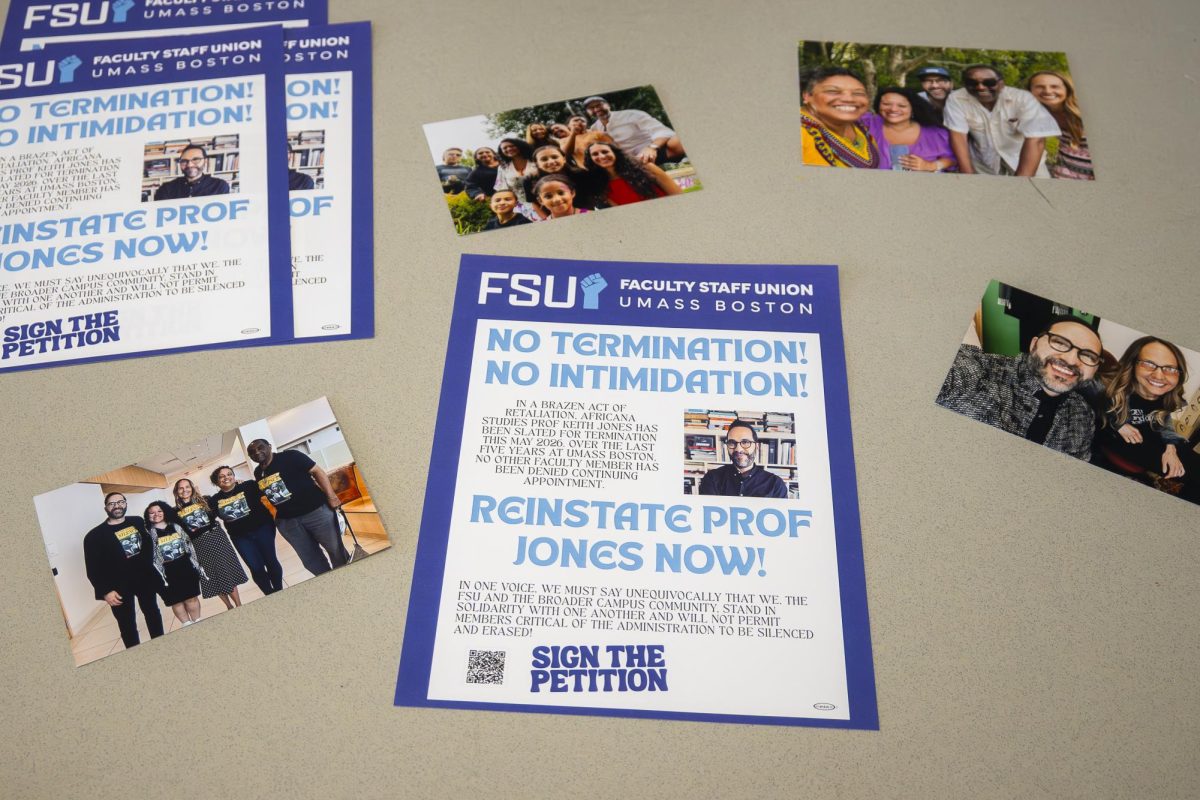
Attending any lecture by Africana studies professor Keith Jones means you will inevitably confront the concrete presence of the dead and will learn how they continue to haunt our discourses. There is a moment during professor Jones’ lectures when you simply cannot comprehend how human beings have demonstrated the utmost, and intentional, disregard for others.
What’s worse is that it’s a disregard that takes expression through the most malicious of means, for heinous objectives, which often require more ruminating than if one were attempting to write a sentence that could contain all of existence in one utterance. But you must confront them and their lingering presence, and it must trouble you, otherwise what accountability means to you and for others cannot be properly defined and escapes one altogether.
That is perhaps the most profound uncovering that occurs throughout a semester with professor Jones: institutions are not self-sufficient entities but are operated by groups of individuals who must be held accountable, whether dead or living, for the political, psychological, and economic repercussions of their decisions and the covering up of those very acts.
It is to hold even one’s self accountable for the discourses entered into, which have been allowed to wholly define the individual. It is to discover behind all seemingly “natural” forms of identification an abundance of nefarious lies and non-sequiturs which we have been taught to simply accept without ever doubting their premises.
It is to question what a classroom should be and what it should accomplish. I have learned from professor Jones that despite what any force of power might say, there is always room for our dead in the classroom. To allow ourselves to forget them would be to wholly disregard the wickedness that ushered them into that foreign state, and, through a continued ignorance of their operations, to continue to only perpetuate their structures.
This accountability for the dead inevitably extends to our own living. And one of the most important conversations about accountability happened in front of McCormack Hall with Professor Jones after his final lecture of the day. At that moment I was very ambivalent about what I wanted to pursue after completing my bachelor’s degree. I knew I wanted to enter into a graduate program but I was unsure of what that would look like for me, or if it was even something I should consider.
Having expressed this to professor Jones, he thought for a moment with the same visible intensity he has when revealing the etymological significance of a seemingly ordinary word. He simply told me to account for who I uniquely was and for what only I could offer; to not concede to the same models of an academic, but to hone my lived experience into research that would honor it.
No doubt, this advice has been given to many other students who have approached professor Jones with the same misgivings. And within his classroom, the emphasis on what each student alone can uniquely bring is always present and no voice is ever disregarded.
A university that proclaims its acknowledgements of the wrongdoings enacted against the dead and living, with a supposed commitment to anti-racist principles, cannot afford to lose such a great educator. In a time defined by an insistence on historical erasure, professor Jones continues to make space for the dead and teaches his students how to honor them through a continued practice of intentional remembrance.