
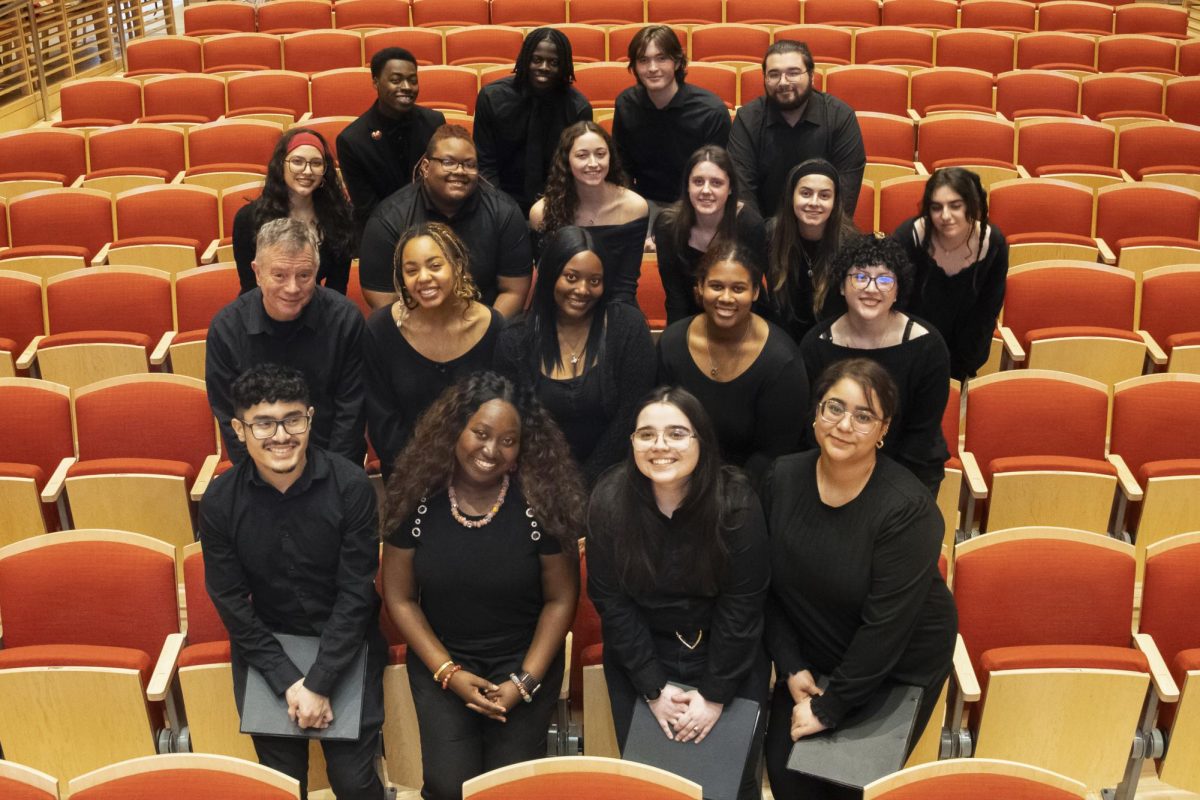
The UMass Boston Chamber Singers and University Chorus will perform a program May 8, commemorating 250 years of American independence and Black History Month.
In the current climate of political unrest, the concert carries a deeper message, inviting audiences to reflect on the enduring struggles that continue to shape the nation’s identity and raise questions about its future. This spring, the Recital Hall will host a repertoire of powerful pieces that highlight the sacrifices of those who built this country, and all are welcome.
David Geissow, a professor and choir director since 2007, will lead 50 voices in song. “The theme came first: America at 250,” Geissow said. “I wondered what other aspects of American history we can and should celebrate, and African American contributions in the field of music have been invaluable.”
One noteworthy piece in the program is “I Dream a World,” with lyrics by Langston Hughes, an American poet, social activist, novelist, playwright and columnist. Hughes is often credited as a pioneer of jazz poetry, and his writing helped shape the Harlem Renaissance in the 1950s and 1960s.
“We do talk about the music as we’re rehearsing it,” Geissow said. “What does this mean? What do we know about this composer or this poet? Sometimes something is hard to interpret, and I’ll ask the students what they think it means. How does it relate to them?”
In 2020, 24/7 Wall St. named UMass Boston the third most diverse university in the United States based on data from the U.S. Department of Education. That distinction is reflected in programs like this one, where a wide range of voices and histories come together to honor both American independence and the cultures that are foundational to this country.
“Music unites everyone, and having that overarching theme to draw people together in addition to just listening to lovely music is important,” said Kristina Gavelis, a junior alto in the choir.
Throughout the semester, students work to perfect each song and create an intricate performance open to all.
For tenor Matthew Sebowa, singing is one of the purest forms of expression. “I’m glad to be a part of a group of people that feel the same way,” said Sebowa. “So many things die, but music never dies. We’re part of the legacy, and we’re keeping these songs alive,” he said.
For Taylor Ventrice, a leading soloist and teaching assistant, the program’s theme is closely tied to the voices and histories it represents.
“America is built on the foundation of people of color. So much of our country can be attributed to the sacrifices made by Black and Native Americans,” she said.
With performances like “A Love’s Splashing Oar,” a traditional Chippewa chant set to music, and “I Choose Love,” the repertoire expands on what American music and identity can look like.
“When you think of America, you think of patriotism. I thought it was impactful to see such a deep focus on Black history and Native American culture. Without them, we wouldn’t have a country,” Ventrice said.
The message is not only in the historical weight of the pieces, but also in their relevance today.
During a time of division and infighting, it is especially important to have spaces of dialogue, connection and collective understanding. “I feel music itself has the power to bring people together because everyone can indulge in art. The sound of unified voices together shows solidarity, even in times when there is so much social divide.” Ventrice said.
A sense of unity is evident in selections such as “No Color,” performed by the Chamber Singers. “I think that piece speaks perfectly to what is going on in the world. The general theme of it is that despite our cultural differences, we are all one,” Ventrice said.
Performers also remain mindful of the responsibility that comes with representing cultures outside of their own.
“I wanted to make sure that as a white performer, I am respectful and aware of my stance. I hope that I can show my appreciation for these cultures,” Ventrice said.
Music has a long history with protest and anti-establishment messages, often being at the forefront of significant change.
“Music activates both sides of the brain. The side for feeling feelings is where the music touches. Choral music lyrics involve comprehension and understanding, and that activates the other side of the brain,” Geissow said. “Combining lyrics and music has the potential to make people feel and have a new understanding of a difficult topic.”
Tickets for the event are available via the Office of Student Activities site.