
Religion has historically claimed to function as a moral framework meant to promote justice, compassion and ethical conduct — however, history has proven how in reality, religion behaves as political authority thanks to its rhetorical usage.
Religious language is frequently mobilized not as spiritual guidance, but as a political instrument. In wars across the Middle East and beyond, leaders and movements invoke sacred texts, divine authority and civilizational narratives to legitimize violence and mobilize support.
Religion and spirituality are two different things, and the latter is cursed by a major issue: its hypocrisy. Spirituality creates the roots from which religion and morals rise. It then was mistakenly transitioned by societies into what we call religion, a much more complex “authority” that spiritually connects billions of people in the belief in a powerful, all-kind and almighty God. This so-called religion came from a morally constructed spiritual belief that then evolved into a political authority. The idea of religion transformed spirituality into politics, where people in power could use it for their own interests.
Belhaj Abdessamad in his book, “The Return of Islamic Rhetoric: Hamas and Conflict Framing in the Gaza War,” defines religious rhetoric as “arguments, metaphors, symbols, or words that have a sacred or authoritative meaning for a given audience.” He then discusses the use of Islamic rhetoric in the most recent Gaza war. Abū ‘Ubayda, the spokesperson for Hamas’ military wing, fills his speeches with religious symbolism and rhetoric to frame the conflict as a religious struggle tied to the defense of Al-Aqsa mosque and the Muslim community. By invoking religious language, Hamas mobilizes supporters, legitimizes violence and portrays the war as a sacred obligation.
The start of the Israeli-Palestine war itself is strongly tied to religion disguised as politics. Since the end of Britain’s control of Palestine in 1948 after the creation of the state of Israel in 1947, we can see the development of the conflict between Israel and Palestine. This conflict is a geopolitical war over the control of the land, instigated by religious hate and differences between Islam and Judaism, which both share Jerusalem as a religious and cultural capital. The United Nations chose to separate the British mandate of Palestine into one Jewish state and one Arab state, a decision strongly influenced by the Zionist Organization of America and the 1917 Balfour Declaration, which supported a national home for the Jewish people. Zionism started as a religious belief that the Jews should return to the promised land of “Zion,” or Jerusalem, to fulfill a Biblical prophecy. Zionism then also became a geopolitical movement in the 19th century, thanks to Theodor Herzl’s claim that Jews are a nation, not just a religion, exhibiting the fine line between religion and politics.
Scholars such as Muhammed Asadi in his article, “Constructing Global ‘Wars Without End’: Vocabularies of Motive and the Structure of Permanent War,” argue that modern conflicts are sustained not only by military power, but also rhetorical constructions utilized by governments. The moral and religious rhetoric surrounding war is used to disguise political and economic interests as a fundamental need to protect civilization.
Religion lost its claimed fundamental principle of unifying people, spreading love, kindness and sharing morals. Instead, it started ruling and manipulating people’s perceptions of right and wrong, instilling fear of the holy punishment.We’ve seen signs of this throughout all documented history, from the “God’s war” in Mesopotamia, to the crusades, the Spanish inquisition and the most recent Israeli-Palestinian War.
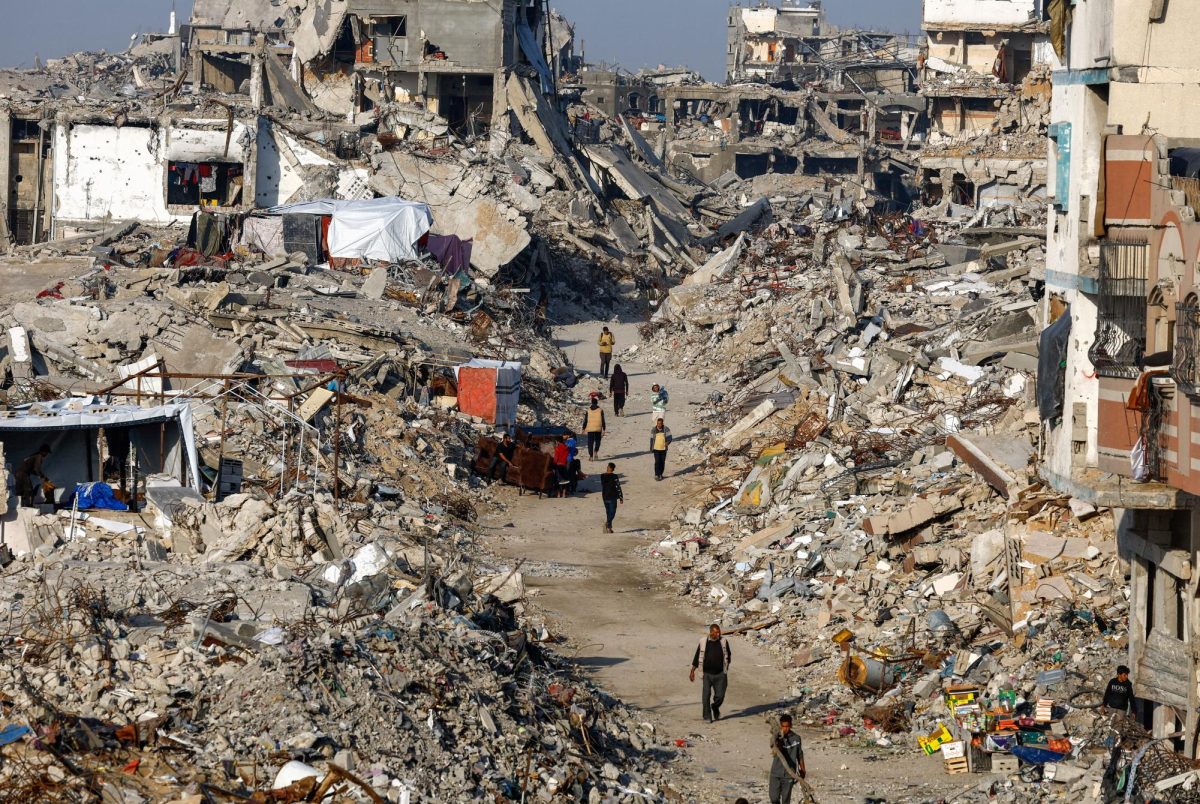
This manipulation of right and wrong is further discussed by scholars such as Peter Wilkin and Efrat Aviv, authors of “Geoculture and the West’s War Against Gaza” and “Religion as a Tool of Outreach: Historical Reflections on the Gülen and Adnan Oktar Movements in Their Relations with Israel” respectively, who argue that Western narratives surrounding the Gaza war rely on moral and civilizational rhetoric that frames the conflict in terms of good versus evil. Political narratives have framed the conflict through a civilizational lens, presenting Israel’s actions as a defense against “barbarism” in a war where identifying whose side is barbaric and whose is civil is nearly impossible. As of right now, this biased rhetoric rooted in religion is trying to justify a genocide.
This is the same rhetoric that forces you to pick a side. While remaining indifferent makes you part of the problem, in situations like this, labeling things as good or bad won’t solve anything. As Friedrich Nietzsche argued in “Beyond Good and Evil,” individuals should develop their own moral judgments instead of adhering blindly to imposed doctrines. This will allow us to escape the militarized rhetoric matrix we are forced into by religion and politics.
It has become clear that religion, while claiming moral guidance and a path towards spiritual values, has been transformed into a political authority, raising the question if there ever was a difference between the two. People believe that if religion says something, then it has to be right, because religion claims to be moral, unmasking its hypocrisy. What we call “religion” was never a “spiritual connection” with something bigger, but always a form of political control disguised as spirituality.