
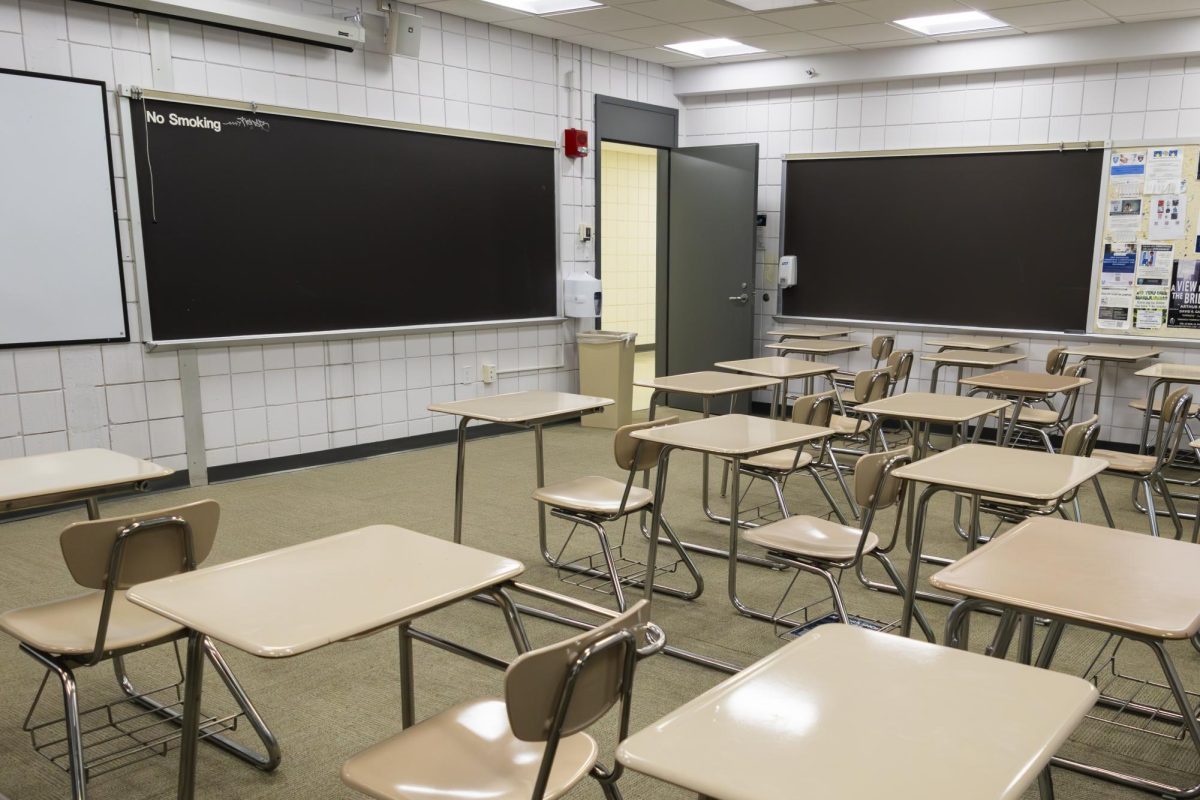
I’m sure that I’m not the only UMass Boston student that has experienced this: you’re making your way to class, possibly running late, trying to navigate your way through hundreds of other students, until you finally reach your class, only to have to cram yourself into a tiny chair and desk combo in a stuffy classroom. If you have experienced this at some point, then you know what it is like to have a class in Wheatley and McCormack hall.
Before I continue, it might seem like this is a minor issue and that I am simply just complaining, but I feel as though the current state of Wheatley and McCormack halls is a lot bigger of an issue than some would think. To start, these two buildings were built back in 1974 and it feels as though neither has been updated at all since then. If we want to discuss Wheatley, we can discuss how navigating your way through the different floors is like navigating a maze, and how the rooms are tightly condensed. Now I understand that it’s one thing for me, a regular UMass Boston student, to come on here and point out these issues — I’m far from the only one — but I think it would be important to hear from a few professors that have taught courses in Wheatley and McCormack.
I had the opportunity to speak with professor Cassandra Alexopoulos of the communications department about her personal experiences with teaching courses in Wheatley and McCormack halls. Alexopoulos has been teaching at UMass Boston since 2017 and in that time, there has not been any substantial change made to either building. “It gave the feeling of a high school when you first walked in,” said Alexopoulos. This type of sentiment is shared across many different students here at UMass Boston. When Wheatley and McCormack, as well as the entire UMass Boston campus were first originally built, they were built in different phases and at different times, meaning that there is a lot of older and outdated infrastructure on campus.
Now, we can sit here and talk about the lack of renovations that have been made to these two campus buildings, but it is also important that we discuss what can actually be done to improve the quality of the campus. The answer, however, isn’t as simple as it might seem. There is a lot that goes into the funding and renovations for the UMass Boston campus behind the scenes that we don’t get to see. Back in February, the Massachusetts Senate passed a bond bill that would fund upgrades for the university, but the bill has not yet officially signed into law yet. I do think that having this extra funding put into the campus would be a major step in the right direction, but unfortunately, it’s all about whether or not the school will ever actually see that funding become a reality.
“I don’t know any specific doable changes” Alexopulos told me. “It takes a lot to actually do a total renovation to the buildings, combined with the fact that there are other campus factors that come into play here.” Unfortunately, this is probably the truth when it comes to the issue at hand. For one, you would need to start renovations as soon as the semester ends and ideally would need to finish by the beginning of the fall semester. That leaves you May to September, four months, to complete renovations and make upgrades to Wheatley and McCormack. Is that really enough time to complete proper, up to par renovations for students and faculty? I would argue that the timing for what you would need to do this isn’t there.
At the end of the day, the main thing you should take from this is not to simply complain for the sake of complaining, but to hopefully get some meaningful change made to these two buildings at some point.