
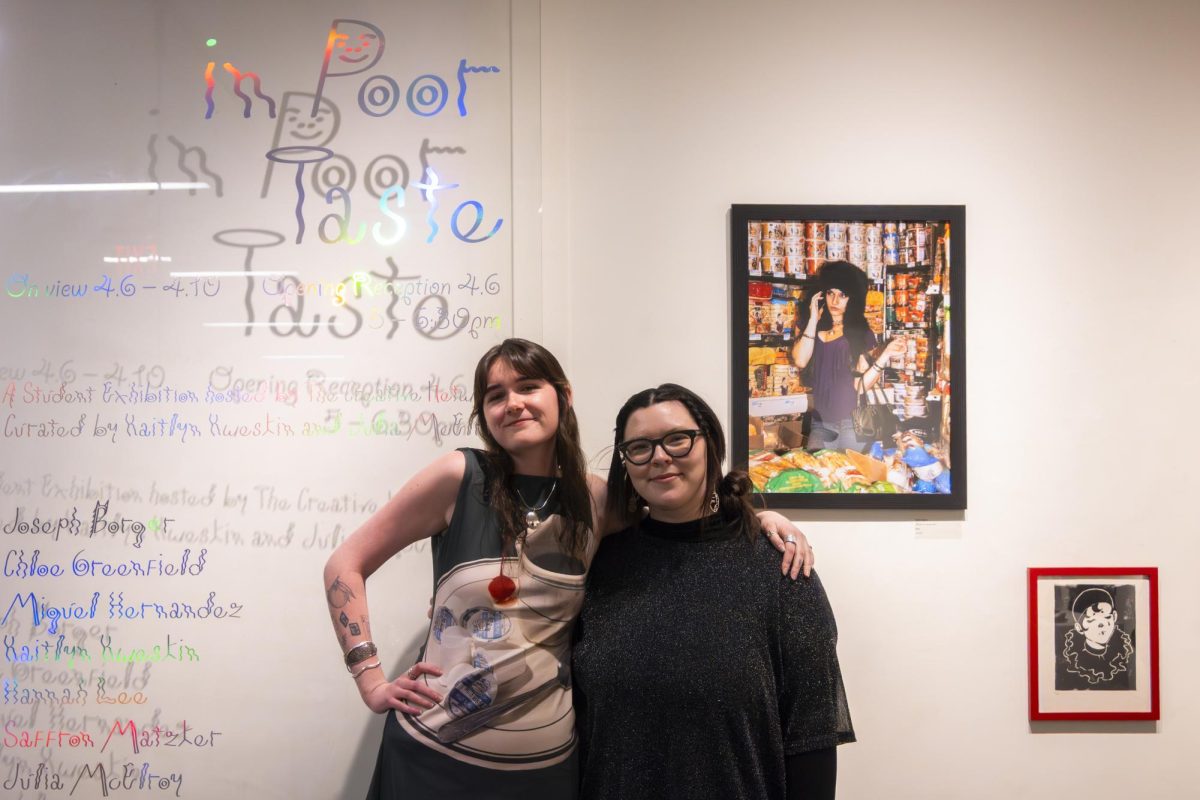
The concept of “poor taste” may seem like an insult, but for student curators Kaitlyn Kweskin and Julia McElroy, it means something entirely different: a playful, inclusive exhibition designed to break down the barriers that often surround the art world.
“We wanted to make a show that felt less serious, something more lighthearted and welcoming,” Kweskin said. “Art can be silly and meaningful at the same time.”
Hosted in University Hall’s Glass Gallery — a space students often find intimidating — the exhibition pushes against traditional expectations of what art should look like and who it is for. McElroy, who works in the gallery, noticed many students hesitate to even step inside.
“They’ll walk in, see the space, and leave,” she said. “It feels sterile, clean and professional. We wanted to change that, to make it feel more like a living space, somewhere people actually want to be.”
The exhibition features 15 works by 10 student artists and grew out of an open call for submissions. Rather than imposing a strict definition of “poor taste,” the curators encouraged artists to interpret the theme on their own terms.
“Art is so subjective,” Kweskin said. “We didn’t want to decide what ‘poor taste’ meant, we wanted students to define that for themselves.”
That openness reflects a broader critique of the art world. Both curators noted that high-priced institutional art can feel disconnected from everyday people.
“Art gets auctioned for millions of dollars, and sometimes it’s not even about whether it’s good,” McElroy said. “We wanted to highlight contemporary art in a way that’s fun, not intimidating, almost a little anti-art, a little Dadaist.”
While the theme encouraged looseness, arranging the works still required careful consideration. The installation process itself became part of the balance between playfulness and intention.
“You might think pieces go together when you’re planning,” McElroy said, “but once they’re on the wall, everything changes. You have to respond in the moment.”
For many artists in the show, the theme offered a chance to question long-held ideas about taste, beauty and value.
Photographer Saffron Matzker embraced a “campy, trashy” aesthetic inspired by early 2000s culture. Her work draws on cluttered, intimate environments and exaggerated personas.
“I wanted it to feel human, messy and real,” she said. “Art can be so focused on elegance and perfection, but what if I want to reflect life as it actually is?”
Matzker created an entirely new photoshoot for the exhibition, inspired by a wig shop she visited the day before.
“The space was perfect, high ceilings but crowded walls, wigs everywhere,” she said. “It had this chaotic energy that fit the theme.”
Her work also centers on empowerment. Through photography, she aims to help her subjects see themselves differently.
“I love capturing people in a way they don’t usually see themselves,” she said. “I want them to feel beautiful and confident.”
While her previous projects leaned more emotional and nostalgic, this series was intentionally lighter.
“This was about having fun,” she said. “It’s a little throwback, early 2000s references, humor, and just enjoying the moment.”
For artist Joseph Borger, “poor taste” took on a more conceptual meaning. His piece, a pair of saws angled toward each other, renders itself unusable, challenging expectations of function and design.
“The goal was to make a tool that defeats itself,” he said. “It looks like it should work, but it can’t.”
To Borger, the subjectivity of taste is central to the exhibition’s message.
“What’s in poor taste to one person could be in good taste to someone else,” he said. “That’s what makes it interesting.”
Borger’s piece focuses on craftsmanship rather than narrative.
“It was originally made for a class,” he said. “There’s not a big message, it’s more about making something well.”
The exhibition is less about defining “poor taste” and more about expanding who gets to participate in art.
“One acceptance can mean everything for an artist,” Kweskin said. “Especially when it’s their first time showing work.”
Both curators hope the show encourages students to engage more with creative spaces, whether by submitting their own work or simply stepping into a gallery without fear.
“Art doesn’t have to be deep or expensive or intimidating,” McElroy said. “It can just be fun.”
They also see the exhibition as a starting point, not an endpoint.
“I hope more students create their own shows,” Kweskin said. “We’ve done this twice now, it’s possible.”
Art isn’t reserved for a select few. It’s something anyone can make, interpret and enjoy, whether it’s polished or serious or, yes, even in “poor taste.”