
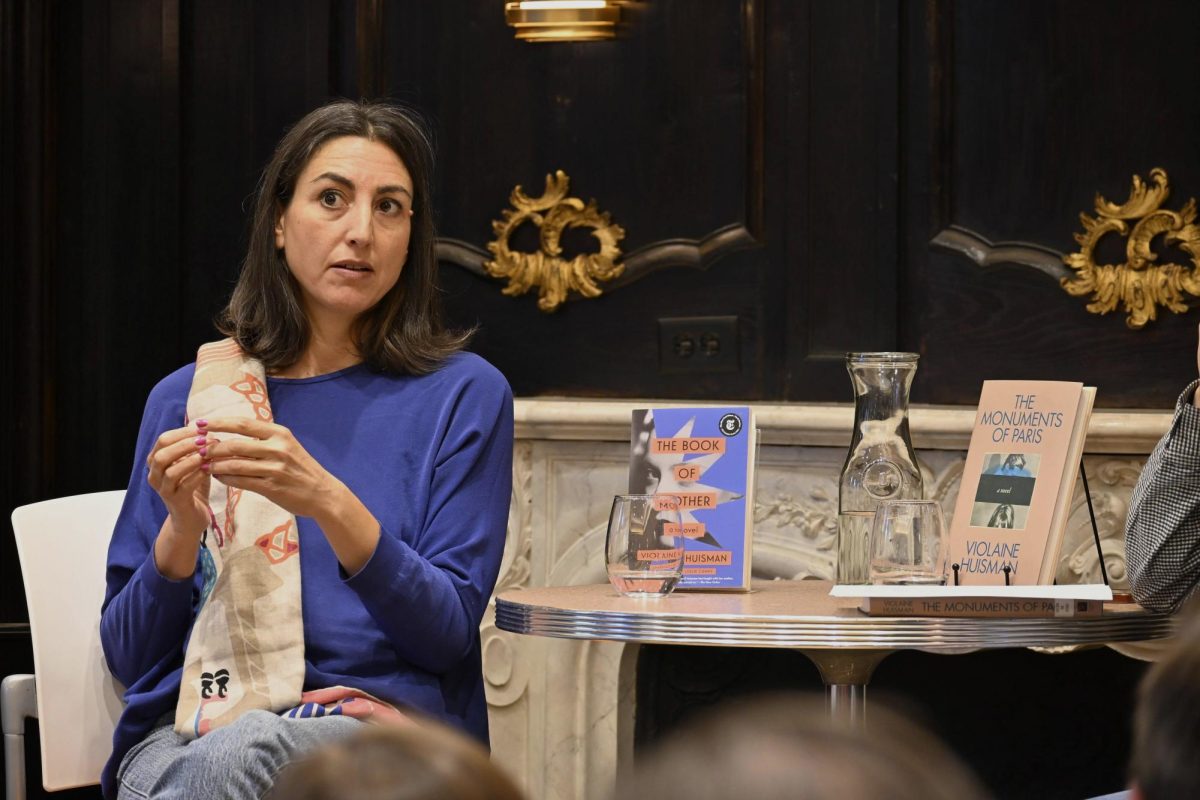
At the French Library in Boston on May 12, author Violaine Huisman spoke about history and the emotional necessity of writing during an event celebrating her newest novel, “The Monuments of Paris.” The evening, hosted in partnership with Trident Booksellers & Cafe, featured a conversation with librarian Benoit Landon, a Q&A session and a book signing reception.
Before the event, Huisman sat down for a private interview where she reflected on the deeply personal origins of the novel and the complicated relationship she has with both Paris and her own family history.
“The project was to try to turn the family history into literature,” she said.
“The Monuments of Paris” serves as the final installment in a trilogy that began with “The Book of Mother,” her acclaimed memoir centered around her relationship with her mother. This time, Huisman turns toward her father and grandfather, Georges Huisman, a French historian and politician who helped found the Cannes Film Festival.
Much of the novel was built from stories passed down through her father, although Huisman said she felt a responsibility to ground those memories in historical research. She described spending years reading archival material and historical scholarship surrounding France during World War II, often following threads of history further back than she initially expected. What emerged from that process was not only a portrait of her family, but of Paris itself.
Although she was born and raised in France, Huisman has spent the last 30 years living in New York. She explained how writing about France from abroad has changed the way she sees the country and even the French language itself. Distance, she explained, has made certain details more visible. Certain details that might otherwise feel ordinary from within France itself.
“I think I have not exactly a foreigner’s view of France, but I have a slightly askance kind of look into what France represents,” she said. “It allows me to see some particularities about France that are difficult to recognize from within.”
That perspective also shaped the novel’s treatment of Parisian identity. Huisman acknowledged the romanticized image Americans often attach to France, though she seemed more interested in exploring the tension between that fantasy and the realities hidden underneath it. Part of the novel, she explained, was an attempt to hold these contradictions together. The beauty associated with Paris exists alongside generational trauma, political violence and rigid social traditions that still linger beneath the city’s glossy image.
Huisman returned to the emotional difficulty of writing about family. She described “The Book of Mother” as an intensely raw experience because of her closeness to the material. “The Monuments of Paris” felt different partly because she was writing about someone she never personally knew. Still, the writing process remained deeply personal. Huisman revealed that her father was dying while she worked on the book, giving parts of the novel an immediacy that contrasted with the emotional distance she felt toward her grandfather’s story.
When discussing her journey with writing, Huisman described growing up in a literary family and, from a young age, feeling a sense of necessity for the craft.
“It takes a kind of a sense of necessity, and I don’t exactly know where this necessity comes from,” she said. “It’s kind of like, you know, your life depends on it.”
When asked what advice she would give to college students and young writers, Huisman rejected generic advice about persistence or passion and instead emphasized clarity of purpose.
“I think it’s most important to have a point of view, to know why you’re writing,” she said. “If you’re really present on the page, if you’re really like a real human being, then there’s a path that you open to a kind of connection. That, I think, can’t be replaced by A.I.”
That answer led naturally into a discussion about artificial intelligence and creativity, a topic Huisman approached with the attitude of many writers and creatives: the real value of literature comes from individuality and emotional sincerity. She referenced a New York Times article by Colson Whitehead, titled “Don’t Use A.I. to Do This”. In it, Whitehead highlights society’s growing reliance on artificial intelligence tools and the serious repercussions attached.
Huisman subscribes to the idea that if you can’t tell the difference between human-produced writing and A.I-generated writing, the writer may be to blame. In such a personal craft, once that personality is taken out of the process, it leaves nothing left but fragments of ideas that are not your own.
“You know, it’s like, what makes the difference, if not a singular point of view, a singular individuality?,” she said.
By the end of the evening, attendees lined up throughout the French Library for copies of the novel, continuing conversations that started during the discussion. More than a standard literary event, the night felt like an intimate reflection on family history and the uneasy process of turning private stories into public art.
