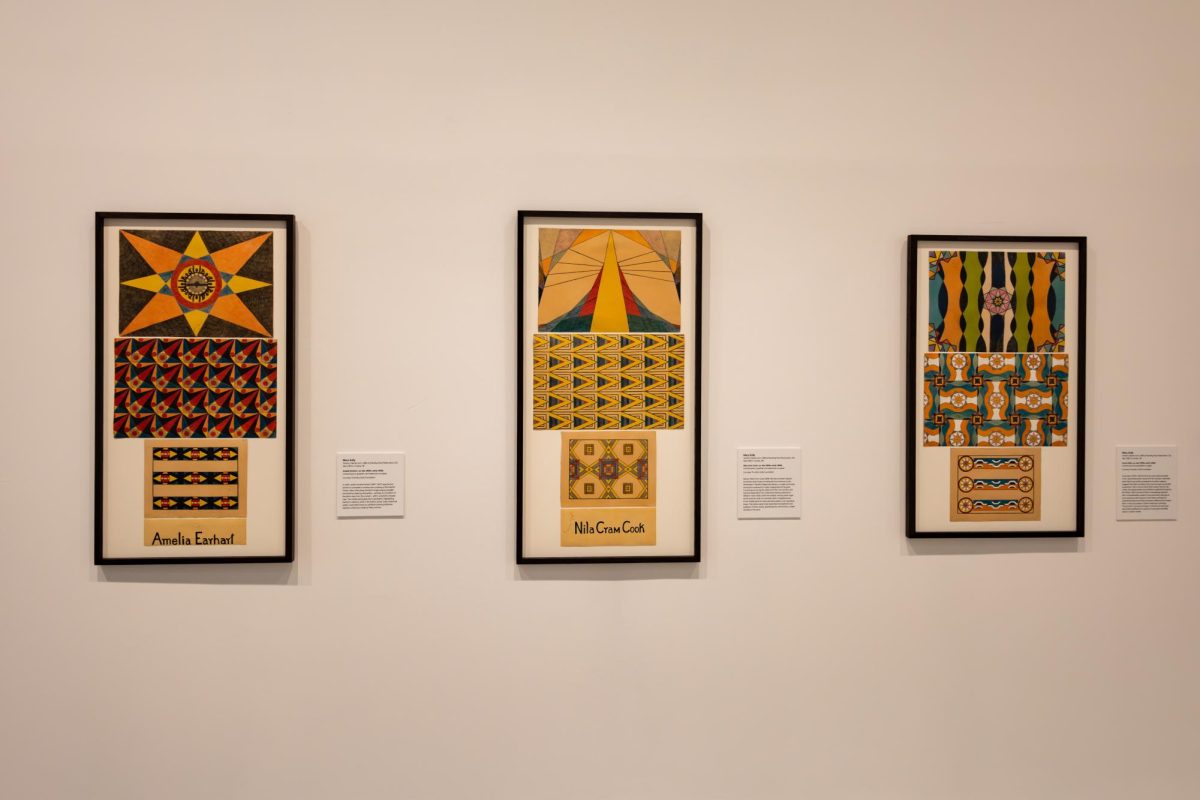
The Institute of Contemporary Art is displaying an exhibition titled “An Indigenous Present,” until March 8.
The exhibition features 15 different indigenous artists, old and young, whose works were curated by artist Jeffrey Gibson and curator Jenelle Porter. The exhibition’s roots are in a book by the same name, published in 2023, that runs approximately 450 pages.
Curatorial assistant Max Gruber was involved in organizing the exhibit. According to Gruber, the book is not a “scholarly tome.” He sees the book and the exhibition as both being part of a “greater intellectual project,” one that focuses on indigenous art from the 1920s onward, an era whose indigenous art doesn’t necessarily get as much exposure.
“The popular perception is that there is less in that time frame,” he said.
Notable among the artists is Mary Sully, much of whose work is thought to have been made between the 1920s and the 1940s. Her works include “personality prints,” abstract depictions of celebrities of that era. Sully’s work received little recognition during her lifetime and any public statements she made about her art are difficult to track down. It is known that unlike some of the more recent artists in the exhibition, Sully’s artwork was not a product of formal education.
“Having work like that art alongside works from people who went to art school felt important,” Gruber said.
When an exhibition focuses exclusively on artists from a certain ethnic group, there can be pressure to make all of the work about heritage and the struggles the group faces, a burden Gruber says we tend to put disproportionately on indigenous artists, artists of color and female artists. He emphasized that Gibson’s curating process explicitly tried to avoid tokenism and balanced the political and the apolitical. That said, Gruber does not feel that the exhibition in any way shies away from the realities indigenous people in the United States have faced and still face now. Though he acknowledged that the violence, displacement and genocide that have marked indigenous history in North America aren’t always obvious to see in abstract art, those issues certainly weren’t avoided.
“It’s absolutely socially conscious,” he said. “The work is very much about engaging with that history.”
The historical elements of the exhibition remains relevant to the present day. Part of the history Gruber references involved people dressing up as Native Americans and tossing tea over the side of a ship in Boston in response to tariffs and contemporaneous issues with international trade. Sonya Kelliher-Combs, another artist featured in the exhibition, has created artwork focusing on subsistence salmon farming in her home state of Alaska. Her hometown, Bethel, is part of an area of the state that recently saw a heavily indigenous population of more than 2,000 people displaced as a result of flooding. Though indigenous history certainly isn’t ignored in the exhibition, the name of “Indigenous Present,” is a statement, according to Gruber.
“Indigenous culture is not something from the past,” he said. “They’re present here, today.”