The university will host eight performances of the electropop musical “Natasha, Pierre and The Great Comet of 1812” by Dave Malloy from Nov. 13-22 at the University Hall Theatre.
Guest Director A. Nora Long and Music Director J. Kathleen Castellanos run the production. The selection of Long as director occurred almost by accident, with Long accepting the position after a friend turned it down because of a prior commitment. Though the play had already been selected as the production for this fall before Long’s involvement, she’d had a long-standing interest in “The Great Comet.”
“I’ve loved this play since it came out,” she said. “I’ve been trying to find an opportunity to work on it.”
“The Great Comet” is sung almost the entire time, with only one line of spoken dialogue. This influenced Long’s decision to cast two different people as Natasha, a young woman who embarks on a scandalous affair while waiting for her fiancé, Andrey Bolkonsky, to return from war. She is seduced by Anatole, whom Long describes as “a too handsome man with ill intentions.”
Hannah Rolston plays Prince Nikolai Bolkonsky, the bitter father of Andrey. Though she has experience playing brash characters in musicals, this is the first musical she’s worked on with almost no spoken dialogue.
“It is a bit of a workout,” she said. “You’re using a lot more of your muscles that people don’t realize you’re using.”
She’s developed a routine of drinking a cup of tea with honey and lemon every morning to soothe her throat and drinking water as soon as she gets offstage after every scene, even if she’s not thirsty. This is in addition to vocal and physical exercises to train her chest, face, and throat.
“It is a beast of a show,” she said.
According to Castellanos, many of the early rehearsals focused on the music, which she says is unique within the musical theater world. Though set in early 19th century Russia, the music is largely electropop. Rehearsals took place five nights a week.
“It’s been taxing, but in a good way,” she said. “It’s hard work, but it’s been good work.”
The show uses immersive seating, with audience members placed in various parts of the theater as the show is performed around them. The seats aren’t necessarily standard theater seats, either. People in the audience might be sat on chairs, couches, or barstools. The setting was part of the original production at the Ars Nova theater in New York.
“We’re taking that and making it our own,” Castellanos said.
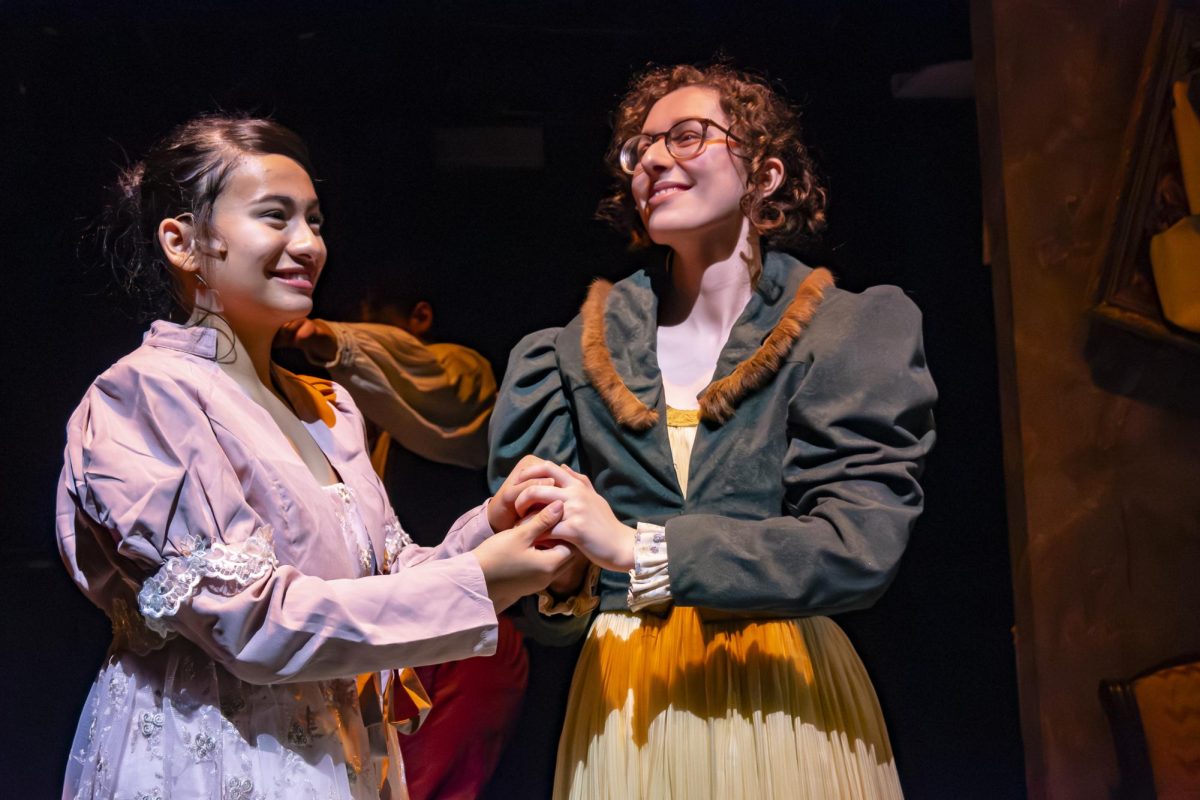
“The Great Comet” was inspired by a 70-page passage from “War and Peace” by Leo Tolstoy. According to Rolston, Long was not very forthcoming in rehearsals with her personal ideas about the characters in the passage, preferring to let the actors develop their own opinions. But Long is unequivocal in her admiration of Tolstoy’s abilities.
“Tolstoy has a really interesting authorial voice that I find very humorous,” she said. “His eye on his characters is very sympathetic but fully acknowledges their weaknesses.”
Long spent three months in Moscow for part of her graduate degree. She arrived the night of an election the Russian government claimed had drawn 100% voter turnout, with a majority supposedly voting for Vladimir Putin. A Russian friend she spoke to about it at the time framed their reaction this way: “Democracy, communism, the tsars—it’s all been the same for the people.”
There’s the question of whether that nihilism and apathy are still present. Tolstoy’s juxtaposition of an aristocratic elite and a peasantry used as cannon fodder in an ongoing war is critical to understanding “War and Peace,” according to Long. And relying on harsh cold and a large population seen as partially expendable in order to fight an enemy remains the same, in her view.
“I often think it’s easier in theater to explore contemporary issues through a historical lens because it offers the audience some distance to reflect on the issue or the theme,” she said.
Rolston has spent three years working in the costume department. According to her, the costumes for the musical are among the grandest she’s seen. Though essentially of the 19th century, she states that there are modern influences as well. She sees the aristocracy’s preoccupation with how they present themselves as being at odds with the realities other Russians are facing.
“Everybody knows that there’s a war going on outside, but we’re trying to pretend that’s not happening on the inside,” she said.
Finally, there’s the dancing. According to Rolston, the physical proximity between dance partners changes in accordance with social norms. Nikolai Bolkonsky keeps his distance. Natasha and Anatole are dangerously close to each other. But this is also an electropop musical, so at one point, there’s breakdancing.
“I think, out of all of the shows I’ve done here, this is definitely the biggest and the boldest one we’ve done,” she said.
Castellanos expressed similar enthusiasm. “I’m really proud of this production, she said. “Because I don’t think you’re going to see anything like this.”