
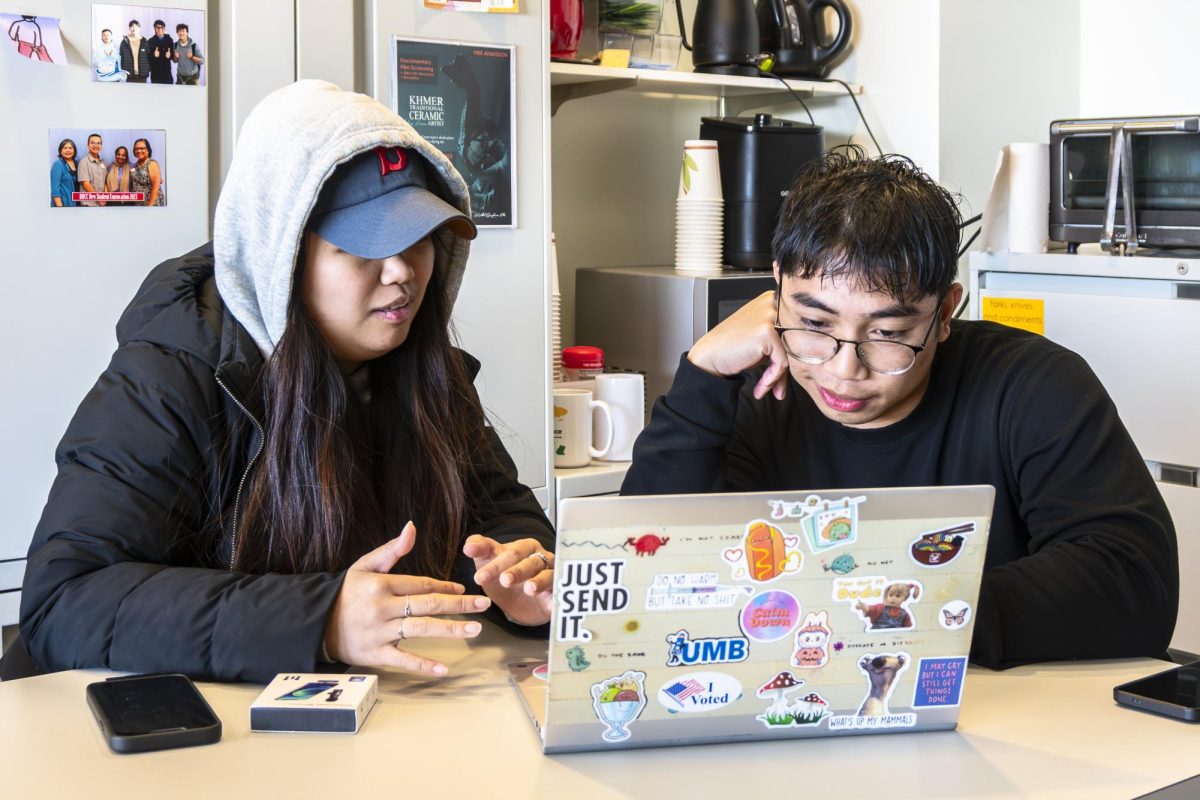
The Asian American Resource Office recently held its second town hall meeting in response to the U.S. Department of Education’s decision to eliminate funding for Minority-Serving Institutions. The meeting outlined current advocacy efforts at both the state and institutional levels, as well as the progress made by student advocates working to ensure the office’s continued support.
For more than a decade, AARO has served the student body of UMass Boston as a federally designated Asian American and Native American Pacific Islander-Serving Institution. Yet that commitment now ends abruptly as federal priorities shift, leaving AARO staff members scrambling to close their doors with little to no notice.
The case of AARO is one of many. Since this past September, the U.S. Department of Education has ceased funding for hundreds of MSIs, including Hispanic-Serving Institutions, Predominantly Black Institutions, and colleges serving Alaska Native, Native Hawaiian, Asian American and Native American Pacific Islander students.
Another academic institution in Massachusetts, Springfield Technical Community College — where more than 40% of students are Hispanic — was forced to relinquish $1.8 million of its $7.8 million federal grant. That funding had been a crucial source of support for the campus STEM center, covering the costs of advisors, tutors and numerous staff positions.
“Cutting this funding strips away critical investments in under-resourced and first-generation students and will destabilize colleges in 29 states,” said David Mendez, interim CEO of the Hispanic Association of Colleges and Universities. “This is not just a budget cut; it is an attack on equity in higher education.”
Similarly, AARO’s struggle reaches far beyond the loss of a single office, threatening the very pulse of the UMass Boston campus. The international student population represents more than 200 countries, while our surrounding neighborhoods — Dorchester, Roxbury and North Quincy — are home to communities in which nearly 50% of families are immigrants. Every breath this campus takes testifies to a legacy of resilience in the face of systemic marginalization, reminding us of the enduring presence we fought to forge atop a discarded 100-acre landfill after the lot near Prudential Center was deemed “too valuable” for us.
What is etched into our history is the strength to overcome discrimination. What is woven into our culture is the instinct to stand with those most vulnerable. We risk letting this shared ethic of solidarity that once united us and set us apart from traditional academia slip away if we grow fearful of the ordinary and too comfortable in our own complicity.
Education should never be reduced to the mere pursuit of a credential or degree. Instead, it should be a holistic process in which students build their identities, develop their skills and cultivate an authentic sense of belonging in order to become well-rounded, virtuous individuals in an ever-changing world.
Of course, none of this is guaranteed simply by being at a college; it also requires student agency. But the collective identity of a university should reflect what higher education means for its students, families, faculty and staff. Supporting AARO is not solely about preserving a program, but also about defending what we still believe this institution can be and the future we believe every student deserves.
Though the fight may seem larger than any one office or community, AARO is not alone in this struggle, and the effects of this defunding are being felt by institutions and students across the nation.
“It’s almost like light from a dying star. It takes a while for the light to be dimmed, even if the star is dead,” said Colleen Lye, the chair of the Asian American Research Center at University of California Berkeley. “Next year, we will actually feel the impact in terms of the [fellowship] recipients and being able to do the operations … Certainly, it feels like everything is an uphill battle.”
However, that does not make what we do and what we stand for in this moment insignificant.
“The fight has always been there — long before AARO and it will continue to remain long after AARO,” said Karen Chi, Associate Director of AARO, at the town hall meeting Nov. 17. “But the struggle, in itself, is a legacy and a testament that we were here, and we believed that our voices deserved to be heard.”
To sign the student-led petition supporting AARO, access this link or email the office at [email protected].