The UMass Boston jazz ensembles performed at Jazz Night Dec. 5 and 6 at 7:30 p.m. in Recital Hall.
The repertoire included standards by Miles Davis, Paul Desmond and Charlie Parker, as well as more contemporary music by artists such as Joshua Redman and Pat Metheny.
None of the selections stretched into the avant-garde, to the reassurance of those concerned about the music being listenable.
“It’s nothing that I think is unapproachable,” bass guitarist Ash O’Brien said. Bandleader Ervin Dhimo concurred. “All this music has form,” he said. “It’s not too abstract.”
Prior to 2022, bandleader Peter Janson conducted a single ensemble. At the time, the group had to turn away musicians because there simply wasn’t enough room for all who applied. However, this all changed when Ervin Dhimo was brought on. Jazz musicians at the university are now divided into three ensembles based on skill level. Two are led by Dhimo; the other by Janson.
The jazz program can now focus on smaller combos without, for example, more than one drummer or keyboardist. This has allowed for a larger number of musicians to develop their skills in an ensemble, according to Dhimo, making it possible for the jazz program to grow and offer greater opportunities to students who play jazz.
“If you don’t have that opportunity, you can’t grow,” he said.
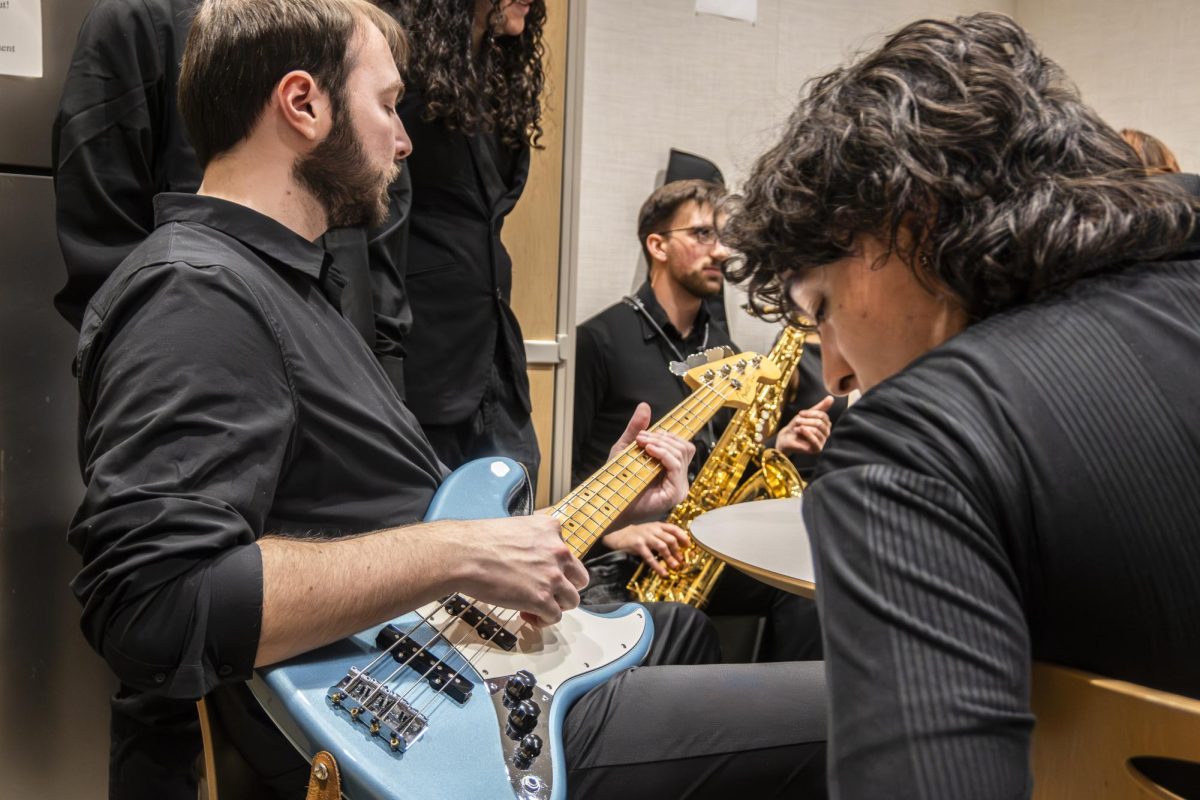
A jazz concert, by nature, involves a certain amount of improvisation based on a given structure. O’Brien, a bass guitarist with Dhimo’s advanced group, has played in the jazz program for five semesters. Both he and Dhimo compare improvising in a concert setting to having a conversation. Though improvising in a concert may seem anxiety-provoking to non-musicians or to musicians from a classical background who are used to playing exactly what’s printed on the page, learning jazz involves learning how to make your own statement based on an existing structure.
“Jazz players don’t really do covers,” Janson explains. “You’re supposed to bring your own twist to it.”
Janson, who has worked at the university since 1991, said he feels real kinship with his students. The son of a jazz guitarist, he’s similar to many students here: a first-generation college student.
“It’s a fantastic place,” he said of the university. “The students are magnificent. It’s a place where we get so much cultural exchange from all over the world.”
He holds a similar view of jazz itself. Though originally an American genre, he feels it has grown since its inception in the early 20th century to reflect a diverse array of influences.
“It’s a very inclusive art form,” he said. “It will take inspiration from every corner of the world and bring it in somehow.”
Jazz nights have been sold out for the last two years, with many tickets selling in advance. In the relatively short time he’s been here, Dhimo says he’s seen interest in what UMass Boston jazz musicians can do to grow. Ahead of the concert, Janson was certain it would not be boring or tiring.
“Keeping it fresh and changing it every day is part of what they have to do,” he said. “And they always rise to the occasion.”