
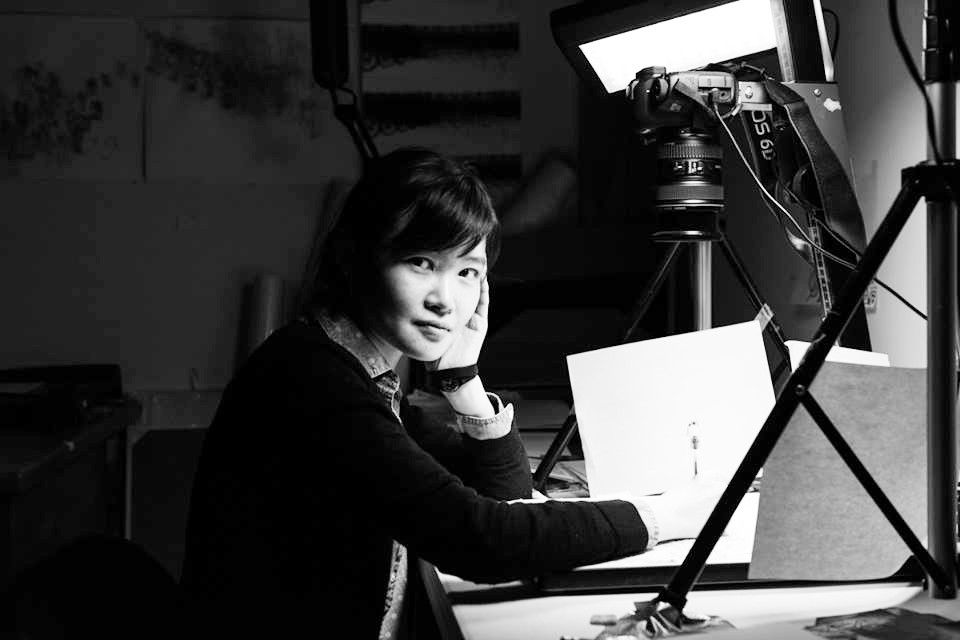
For assistant professor of art Kakyoung Lee, making images has always been a way to understand the world around her.
Long before she thought of art as a career, she was drawing cartoon characters as a child in South Korea, cutting them out and turning them into paper puppets to share stories with friends. Drawing, she said, felt like a way to build a world and invite others into it.
That impulse towards storytelling has stayed with Lee throughout her career, shaping a practice that combines printmaking, animation and installation. Now based in the United States and teaching at UMass Boston, Lee’s work focuses on everyday gestures and the quiet experiences that often go unseen, particularly with immigrant communities.
Lee grew up in a rural area of South Korea where her parents ran a hardware store seven days a week. With long stretches of time on her own, she spent her days wandering outside, observing and sketching what she saw. She was drawn to moments that felt small but meaningful, like flowers growing at street corners, abandoned houses beside new high-rise buildings and people passing through markets.
“I was drawn to images that carried narrative,” Lee said. “Small moments often hold something larger.”
A turning point came in high school when she encountered the work of German artist Käthe Kollwitz during a museum visit. One print in particular, depicting a mother holding a child, stopped her in her tracks. Beyond the emotional weight of the image, Lee was struck by the physical qualities of printmaking, from the softness of the pencil marks to the depth of dark ink pressed into paper.
That experience led her to apply to art school as a printmaking major. After four years of studying the medium, Lee realized for the first time that being an artist could be her life’s work.
After graduate school in Seoul, Lee worked as an illustrator for newspapers, magazines and children’s book publishers while continuing to exhibit her own work. The pace was demanding, with constant deadlines and long nights. Eventually, she knew she needed space to develop her personal practice more fully. She applied to print- and book-arts programs in the U.S. and received a scholarship to the graduate program at SUNY Purchase College.
The move reshaped her understanding of printmaking. While studying in New York, Lee saw a retrospective of artist William Kentridge, whose animated drawings and use of erasure opened new possibilities for her. She began to see printmaking and animation as deeply connected, both rooted in repetition, layering and the passage of time.
“Printmaking records time through process,” Lee said. “Each test print holds an image at a moment in its evolution.”
Today, Lee’s work often blends prints and moving images, allowing viewers to experience how subtle changes accumulate over time. Her recent solo exhibition at the List Gallery at Swarthmore College brought together prints and animations in a shared space, encouraging visitors to move between stillness and motion. Another exhibition, “Layers of Invisibility,” at PS122 Gallery in New York, pushed her further into experimental video installation, including a series of animations centered on the idea of moving day as a metaphor for immigrant life.
Themes of visibility and invisibility run throughout Lee’s work. She is interested in how daily labor, care and routine often go unnoticed, even though they shape personal and collective histories. By focusing on ordinary gestures such as walking, jogging or passing through space, she aims to highlight the emotional weight carried by repetition.
At UMass Boston, Lee brings these ideas into the classroom. As an assistant professor, her responsibilities include teaching, service and maintaining an active creative practice. This spring, she is teaching Intro to Printmaking and Printmaking Workshop, courses that emphasize both technical skill and conceptual development.
Lee encourages students to see printmaking not just as a technique, but as a way of thinking. She asks them to start from lived experience and to develop a visual language rooted in what they know. In critiques, students articulate their intentions and examine how their work communicates visually and emotionally.
“I want students to leave with skills, but also with confidence in their own curiosity,” she said.
In her studio, Lee is preparing for an upcoming exhibition called “In Transit, In Formation” at the Korean Cultural Center New York, opening March 4. The show will feature animations projected on large wall screens and continue her exploration of movement, memory and immigrant identity.
As her practice continues to expand into larger, multi-channel installations, Lee remains committed to creating work that invites reflection rather than relying on theory alone. Whether through print, animation or teaching, her goal remains the same: to make space for stories that deserve to be seen.
