
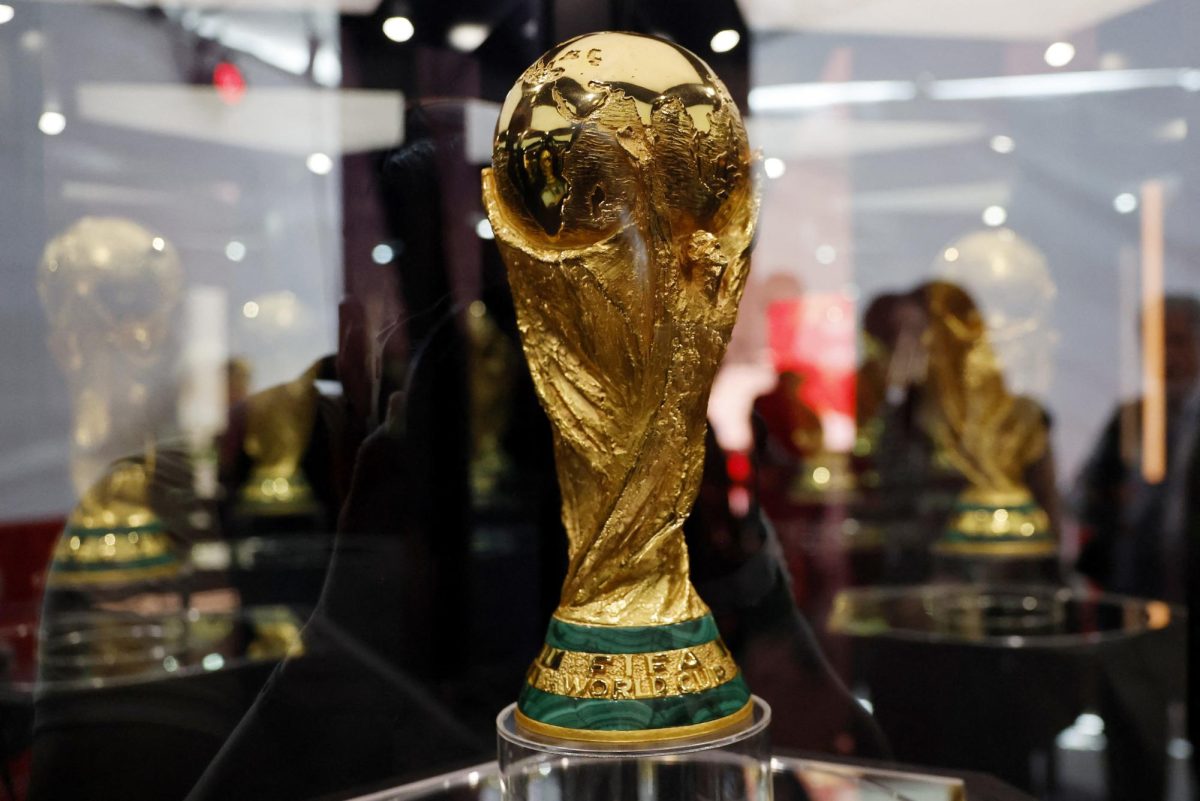
As Boston prepares to host thousands for the FIFA World Cup tournaments at Gillette Stadium, you might be thinking: How does the World Cup work? Is it in Boston the entire time? How long is it going on for? In a culture that emphasizes American football over association football, the impending event might seem like a confusing nuisance — so here is everything you need to know about the upcoming World Cup.
The 2026 FIFA World Cup begins on June 11 and finishes July 19, but it won’t be in Boston the entire time. Hosting this year is shared between Canada, Mexico and the United States. 16 cities will host games: two in Canada, three in Mexico and eleven in the United States, including Dallas, Philadelphia, Miami, and of course, Boston.
Boston will host seven matches total. There will be five Group Stage matches — Haiti vs Scotland June 13, Iraq vs Norway June 16, Scotland vs Morocco June 19, England vs Ghana and Norway vs France — as well as a Round of 32 game and a Quarterfinal. The games will be played in Foxborough at Gillette Stadium, now renamed Boston Stadium due to FIFA’s strict rules regarding brand sponsorship. Every cities’ stadiums had their sponsored titles removed and replaced with the area name.
The Boston matches will take place on June 13, June 16, June 19, June 23, June 26, June 29, and July 9. On the day of each match, 14 express commuter rail trains will be running from South Station to Foxboro Station. The return trains will leave 30 minutes after the final whistle and every 15 minutes after that. Every subway line and some bus lines will run extended hours on game days. Commuter rail service outside of the designated Foxboro trains will be reduced for all five weeks of the tournament. There will be additional service changes on specific game days for trains coming in and out of South Station.
To really understand the hype, you need to understand how the World Cup is structured. 48 countries qualify from different regional confederations, such as the Union of European Football Associations and the South American Football Confederation. These teams are then split into 12 groups of four and play within their group until each of the four has competed against one another. This Group Stage will take place from June 11 to June 27. At the end, two winners from each group move to the Round of 32, making up the first 24 qualifiers. The additional teams are the top eight scoring teams across all of the runner-ups.
Then, the 32 teams compete in single-elimination playoffs. Each match consists of two 45-minute halves, the typical for soccer. If time is up and the teams are tied, it will go into overtime with two 15-minute halves. These must be played for the full time, even if a team takes the lead. If, for some reason, there is still a tie, the game will turn to a five-round penalty shootout to decide. A penalty shootout is when both teams take turns kicking from the penalty line, 12 yards away from the net, against only the opposing team’s goalie. After that, any subsequent rounds are sudden death, meaning that the two teams take turns kicking until one scores when the other misses.
The Round of 16 is formed with the winners from each Round of 32 game. Playoffs continue from there into the Quarterfinals, Semifinals, and Final, still in a single-elimination bracket. There is also a Match for Third Place, in which the two losers of the Semifinals play off to decide who will take third.
In addition to millions of dollars in prize money for each team, five awards are given out after the final match’s conclusion. The Golden Boot goes to the individual who scored the most goals throughout the tournament; the Golden Glove goes to the best goalkeeper; the Golden Ball goes to the best overall player; the FIFA Young Player award goes to the overall best player under 21; and the FIFA Fair Play Trophy goes to the team with the best disciplinary record that reached the Round of 32.
This year, the United States team has two connections back to Boston. Arlington native Miles Robinson will be playing as a defender. Robinson started on the Boston Bolts, a highly regarded youth team, before going to FC Cincinnati and is the first player from the Cincinnati team to make it to the World Cup. The goalkeeper for the team is Matt Turner, who is also the goalkeeper for Gillette Stadium’s usual men’s soccer residents, the New England Revolution. This is Turner’s second time as the starting goalkeeper for the USA team, standing out in the 2022 FIFA World Cup after becoming the first U.S. Men’s National Team goalkeeper with multiple shutouts in the World Cup since 1930. He blocked the other teams from scoring completely in Qatar against England and Iran, tying one game at 0 and winning the other.
The World Cup is about more than soccer. It’s about community and celebrating the worldwide reach of the sport. Now that the event has been demystified, anyone can go out and root for Turner and Robinson with their comrades or get into heated arguments at the bar about Brazil’s chances of taking it all home.
