


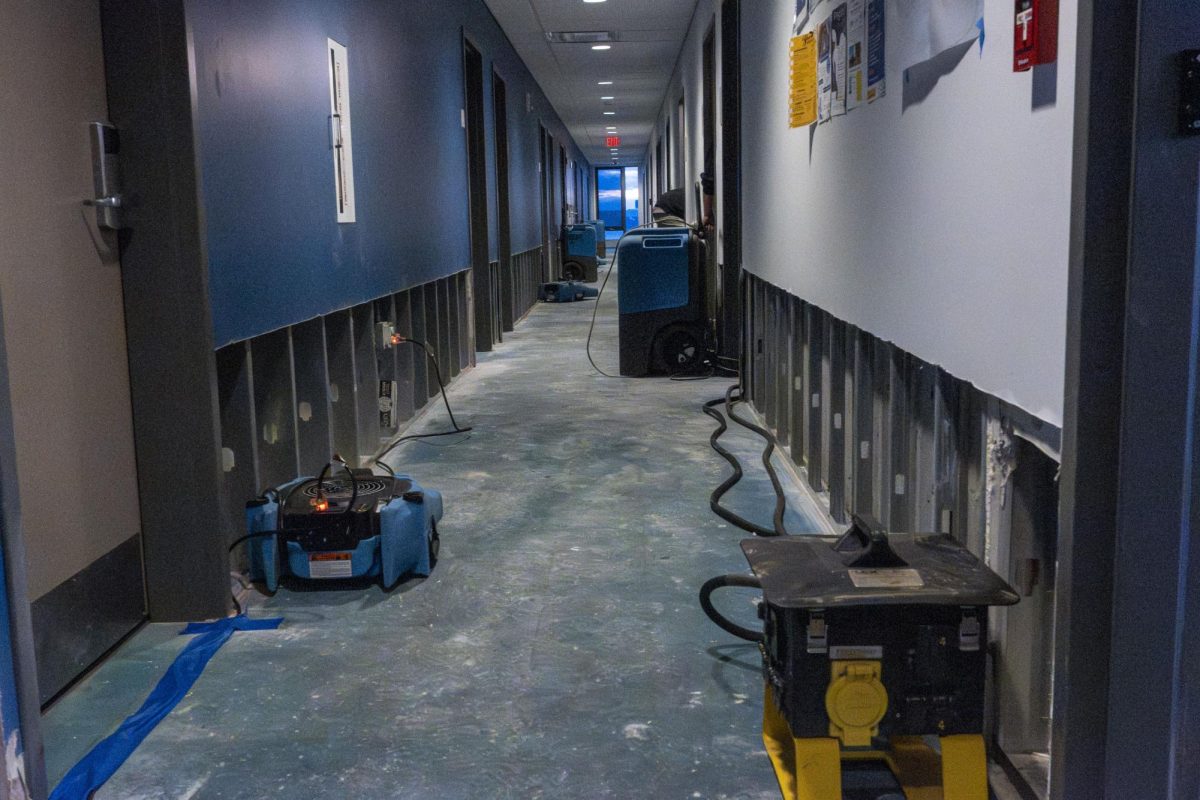
More than 600 students were displaced Feb. 9 after a sprinkler pipe on the 10th floor of the East Residence Hall burst, causing flooding and requiring the building’s closure.
The building remained entirely closed until the morning of Feb. 11, when the Dining Commons on the first floor reopened for regular meal hours. Officials began allowing residents to return to their rooms with a staff escort to gather essential belongings that afternoon. As of Feb. 15, the university has not announced a timeline to reopen the rest of the building.
“We recognize that for many students these visits were emotional and difficult. We appreciate the care, respect, and resilience our residential students have demonstrated throughout this process,” Vice Chancellor for Student Affairs Karen Ferrer-Muñiz and Vice Chancellor for Administration and Finance Kathleen Kirleis wrote in a joint email Friday.
The university cannot reopen the residential floors until they receive approval from state inspectors. “Fire suppression has been restored throughout the building, the emergency generators were successfully tested, and electrical systems performed well in testing, meeting the next layer of milestones required by safety inspectors,” Ferrer-Muñiz and Kirleis wrote. They are waiting for an electrical engineer’s approval and for repairs to the the central staircase, which is required for fire egress.
Michael Metzger, the assistant vice chancellor for student affairs, said inspectors allowed the university to reopen the Dining Commons ahead of the rest of the building because it operates on separate electrical systems and occupies an area of the building that is one-story high, meaning it is not below any area affected by the flood. The western wing of the building was mostly unaffected by the flood damage, Metzger said, but cannot be reopened on its own because its electrical systems run through the flooded areas. The 11th and 12th floors are also unaffected, but cannot be reoccupied until damage to the staircase is repaired.
144 affected students are staying in alternative housing at UMass Amherst’s Charles River campus in Newton, formerly known at Mount Ida. Shuttles between the two sites run hourly, but the drive can take more than 40 minutes, even without traffic. The university will also cover the cost of round trips between the Charles River campus and University Station, a shopping center in Westwood, via Uber for Business, according to the “Residence Hall Support” webpage.
Other residents are staying in hotels, on friends’ couches or in common rooms of the West Residence Hall. UMass Boston Director of Communications DeWayne Lehman said accommodations at the Charles River campus were offered to all East Hall residents, but many chose to commute or find their own housing. Because most are temporarily commuting, affected residents received a free parking pass applied automatically to their Beacon Cards.
Approximately 50 rooms housing 91 students sustained significant damage as water spread through walls and between floors. “Students in these impacted rooms are being asked to fully move out and remove their belongings so that repairs can commence, including removal of damaged drywall, flooring, and ceiling materials,” Ferrer-Muñiz and Kirleis wrote. “Students in impacted rooms will be relocated to alternative housing for a longer duration while repairs are completed. We are actively working to secure additional longer-term housing options and expect to share additional details within the coming days.”
Flood remediation contractors arrived on campus approximately three hours after the flooding began. Since then, they have removed wet carpet, cut away the bottom of walls and placed industrial blowers and heaters in spaces affected by the flood. There was no obvious moisture remaining in the 9th or 10th floor hallways, nor any smell of mold, as of 5:15 p.m. Feb. 11 when The Mass Media was granted access to tour the building.
Residents and staff members who entered the high-impact rooms said they were still wet and smelled of mildew Feb. 13. Administrators notified the affected residents that they need to move out by the afternoon of Feb. 14 in an email Feb. 12, which included that the university is offering professional laundry services for wet items. “If you carry renters or personal property insurance, we encourage you to contact your insurance provider promptly regarding documentation and potential claims,” the email said.
“We will provide moving trucks to transport student belongings to nearby short-term storage units,” the university wrote in a follow-up email the next morning. According to an email sent the same day, emergency grants of up to $1,000 are available to affected students via the Beacon Student Aid Fund.
Megan Sullivan, the vice chancellor for marketing and engagement, said Feb. 11 that the university reached out to students in the high-impact rooms separately before allowing anyone to gather their belongings. Administrators are working on ways to help affected students replace damaged items, she said, confirming that the university does not intend to force students to rely entirely on renters’ insurance.
This article appeared in print on Page 1 of Volume LX, No. 10, published Feb. 16, 2025. Read our live coverage for more information as the story develops.
