
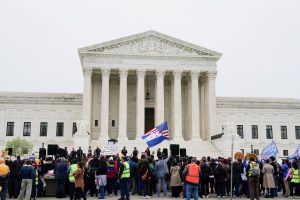

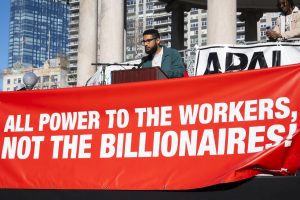
Boston teamed with activity May 1 as activists and coalition members gathered for rallies to celebrate May Day — International Workers’ Day — and protest a wide range of political and economic issues facing the nation.
Rallies were held throughout Boston, including at Logan Airport, the State House and on the Boston Common. Anti-ICE advocates from LUCE, the Immigration Justice Network of Massachusetts, rallied outside of the State House to protest ICE’s actions in Massachusetts and to raise awareness for the struggles that communities have faced under the Trump administration’s mass detention campaign against immigrants.
Additionally, the Boston Teachers Union led a march from City Hall Plaza to the Common, where thousands gathered for the day’s main event. Speakers included representatives from labor organizations of Boston and Massachusetts, members of the Democratic Socialist Party of America and anti-war advocates.
Demands of the speakers included that ICE be barred from operating in courts and schools. The contribution immigrant workers make to the US economy was central as well, with some suggesting that the country could not function as it does without their labor. Others shared their personal stories of the hardships that they or their loved ones have gone through at the hands of ICE.
The speakers tied our current moment in time — the rising threats of authoritarianism, AI, global warfare and domestic wealth inequality — with the system of capitalism and the imperialist violence it perpetuates. They spoke of the essential nature of unions in combating labor exploitation, and the imperative of everyone to ensure social justice is upheld for all. Most importantly, the idea of sustained action beyond May Day was hammered home time and time again.
“The most important focus is on the workers,” said Kayin Walker, treasurer of UMass Boston’s Students for Justice in Palestine, in an interview with The Mass Media. “Workers are the oil that keeps this world moving, and it is on us to help them feel appreciated for their hard work and dedication. We must recapture the true essence of International Workers’ Day as a larger effort towards liberation for all. That’s what I’d like people to take away from May Day. If we hope to liberate all, we must focus on the intersection between all struggles.”
Wider action in the Boston area was also supported by activity at UMass Boston. Students coalesced on the front lawn to speak on the affordability crisis and other aspects of campus life plaguing the student body. At the forefront of student speeches was the question of parking rates, which the administration recently announced it intends to raise to $18 per day. Also prevalent were concerns surrounding the department of Africana Studies and the Asian American Resource Office. Speakers noted the uncertain future of AARO as it faces defunding related to cuts by the U.S. Department of Education, and expressed outrage at the attacks facing the Africana Studies department — the culmination of which was the firing of Professor Keith Jones. The main emphasis, however, was on solidarity among workers and heightened consciousness of the greater system.
“Once we identify a common oppressor, we must unify our efforts to eradicate it,” Walker said. “We must take the time to understand one another on all levels; only then can we begin to realize that our individual struggles are all interconnected within a system which functions on imperialistic ideologies.”