


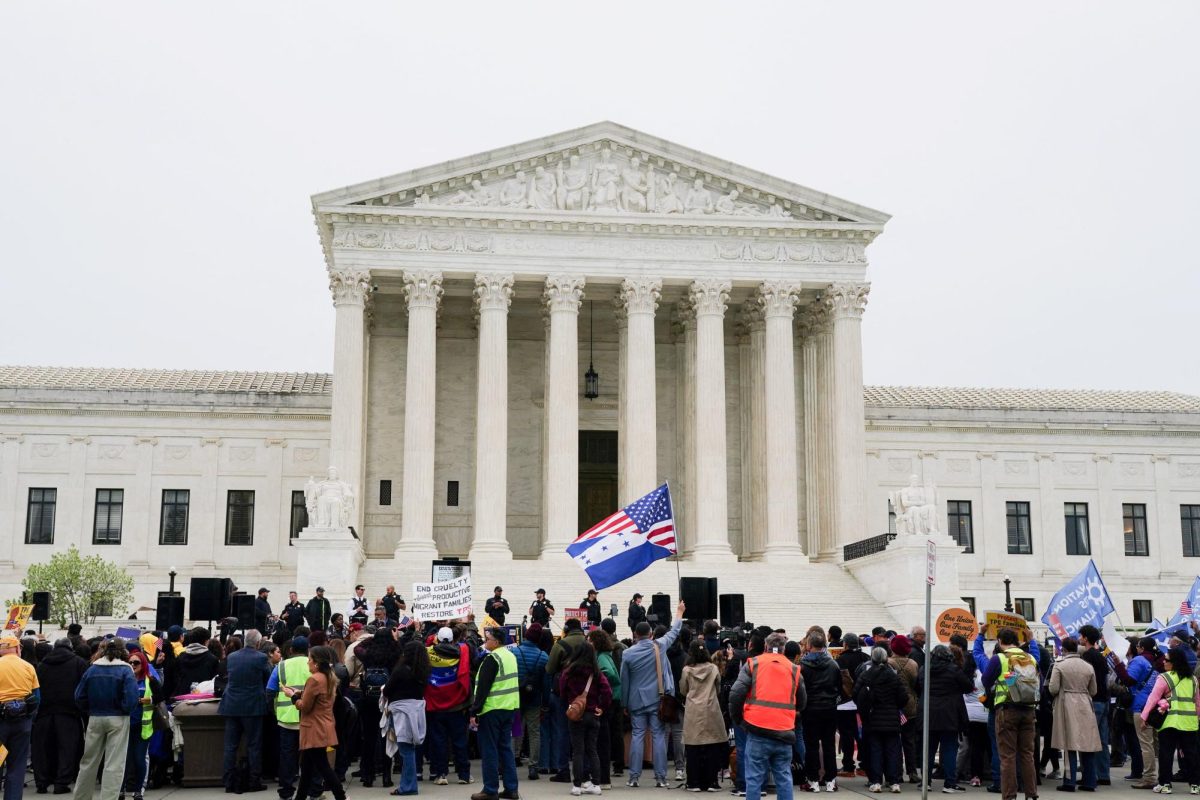
Immigrant advocates, alongside Mayor Michelle Wu and other elected officials, gathered July 23 in Boston’s City Hall Plaza urging Congress to approve a bill which would extend the Temporary Protected Status for Haitian and Syrian immigrants.
The bill, S. 4814, was proposed by several lawmakers, including Massachusetts Senator Ed Markey, and would extend TPS for Haitians until January 2029. Currently, the bill remains in the upper chamber after it was blocked from passage by Senate Republicans July 22.
Over 40 organizations participated in the demonstration, such as the Massachusetts ACLU, Massachusetts Immigrant & Refugee Advocacy Coalition, and Local 26, according to a flyer posted by the Immigrant Family Services Institute. Dozens of community members also attended.
On June 25, the United States Supreme Court ruled 6-3 in the case of Mullin v. Doe, a lawsuit brought against Department of Homeland Security Secretary Markwayne Mullin by a collective of Syrian and Haitian nationals, to uphold the revocation of TPS for both countries. After the decision, Haitians and Syrians were set to lose their TPS July 10. However, the Department of Homeland Security extended the expiration date until July 24 in a memo released that day. On July 22, a federal appeals court extended the expiration to July 27.
Wu made a statement at the IFSI press conference the day of the SCOTUS ruling, as well as two posts on Instagram criticizing the Supreme Court’s decision.
“The City of Boston condemns this decision by Donald Trump’s enablers on the U.S. Supreme Court to allow the administration to end protections for TPS holders. This ruling is as cruel as it is lawless. The justices have ignored the findings of our own government in a decision that will put lives in grave danger,” she wrote in a June 25 post.
Wu continued, “America has needed serious immigration reform for over a generation. Instead of doing the hard work to improve the asylum system and create pathways to citizenship, the Trump Administration is targeting people who came here seeking safety from violence.”
Originally, TPS was expected to expire Feb. 3 following an announcement made by former DHS Secretary Kristi Noem in November 2025 that Haiti no longer met the qualifications necessary for the temporary protected status. However, a D.C. district court judge issued an order delaying former Secretary Noem’s decision until this month’s SCOTUS ruling authorized the Trump administration to officially end it.
Immigrants from Haiti were granted TPS in 2010 after a devastating 7.0 magnitude earthquake left an estimated 316,000 people missing or killed, according to the United States Geological Survey. The destruction left roughly 1.3 million homeless, and TPS became designated for Haitians Jan. 21, 2010, nine days after the earthquake. Haitians have continued to receive TPS due to political violence and unrest that escalated following the assassination of Haitian president Jovenel Moïse in 2021.
According to the research and advisory firm Neilsburg, Boston has a population of over 19,000 Haitians, many of whom will be required by law to return to Haiti once the ruling goes into effect or risk deportation.
In a letter sent to former Secretary Noem Jan. 30, Massachusetts Governor Maura Healey cited that TPS eligible Haitian immigrants contribute $4.4 billion annually to the U.S. economy and that many have children who are U.S. citizens. Healey also emphasized the “indispensable” role that Haitians with TPS hold in healthcare and the problems that worker shortages would cause.
Boston City Councilor Ruthzee Louijeune spoke at the event about the economic and human consequences of the SCOTUS ruling. She said, “This decision to end work authorization for people who add billions of dollars in taxes to our economy is a disgrace… As a proud daughter of Haitian immigrants, I feel shame in this moment at what they are doing to our country. I feel shame in a Supreme Court which ignores the very clear racism and racial animus of this administration time and time again. This is not who we are, and this is not how we build the country that we believe in.”
Wu, in a July 23 Instagram post about the rally, also highlighted the impact Haitian immigrants have had on the economy. “Boston is home to the most passionate Haitian community in the United States-and for decades, they have shown up for us. They have worked demanding jobs that our communities depend on. They have paid taxes. They have raised families. They have cared for our sick and our elderly with extraordinary compassion. They have done everything this country has asked of them, and more,” she said.
Wu continued, “Boston se lakay yo-Boston is their home. We know how deeply they care for our city and our country. We need to show that same care.”