UMass Boston made more than $300,000 in payments to a bank account belonging to the Vatican’s Pontifical Academy of Social Sciences in connection with the March 27, 2025 ResilientMass climate summit hosted on campus, The Mass Media has learned.
The summit, which the university said was “sponsored by the Pontifical Academy of Sciences,” was one of a series following the Vatican Climate Summit hosted by Pope Francis in May 2024. Documents show that university staff led efforts to plan and fundraise for the event and for others around the world, using official email accounts and other university resources to do so.
In a statement, Director of Communications DeWayne Lehman wrote that all funds for the summit came from private donors. “UMass Boston has served as a conduit for philanthropic donations to fund other regional summits,” Lehman wrote. “UMass Boston professional staff are paid on a salary basis, which represents a fixed annual compensation for all work performed on behalf of the university … The climate resilience summits are part of the university’s ongoing advocacy and leadership on this very important, global crisis.”
In 2025, the university identified five invoices it paid in response to a public records request seeking budget documents and receipts from the summit. The invoices, totaling $26,712, included expenses for space use, event management services, badges, catering and printing.
Documents identifying other transfers were among more than 2,000 emails about the event received by Matthew Fenlon, the assistant chancellor for government relations and special assistant to the chancellor, which were provided to The Mass Media nearly a year after they were first requested. The university required The Mass Media to pay $1,141.67 in fees to access administrators’ emails, citing a student privacy law. Administrators continue to withhold emails belonging to Chancellor Marcelo Suárez-Orozco and Chief of Staff Peter Kelly.
The $315,000 wire transfer — arranged by Suárez-Orozco and Fenlon — was sent to the Vatican “to support the Vatican Secretariat’s work for the Climate Resilience Regional Summits,” Suárez-Orozco wrote in an email to Cardinal Peter Turkson and Pontifical Academy of Social Sciences President Helen Alford. Suárez-Orozco is a member of the executive committee of the Pontifical Academy of Social Sciences, appointed by the late Pope Francis. Turkson is the chancellor of the organization.
Days earlier, the university made a transfer of $80,300 to the same account “to support the AI, Justice, and Democracy Project,” according to the email.
Lehman declined to identify the donors, referring to their identities as “trade secrets” and “proprietary information.” Emails between Suárez-Orozco and Fenlon identify donors including the MacArthur, UMass, Bertelsmann and Blue Chip foundations. They also show that the university solicited donations from the Waverly Foundation, the Emerson Foundation and Amos Hostetter through Joseph Kennedy, the former congressman and special envoy for Northern Ireland.
UMass Boston served as the middleman for a $101,500 donation from the Blue Chip Foundation to the University of California at San Diego in connection with the summits. The funds “will be channeled through the University of Massachusetts, Boston (a collaborating institution in the broader Climate Resilience initiative),” a UCSD finance manager wrote in an email to Fenlon.
The university also handled $167,300 from the Bertelsmann Foundation to fund the European regional summit. “University of Massachusetts Foundation, Boston is the organizer of the European summit conference and responsible for the whole organizational process,” the donation agreement said. The UMass Foundation received the funds and transferred them to a special university account under the chancellor’s office days later, emails show. The UMass Foundation is “a private, independent nonprofit,” according to its website.
Police Presence
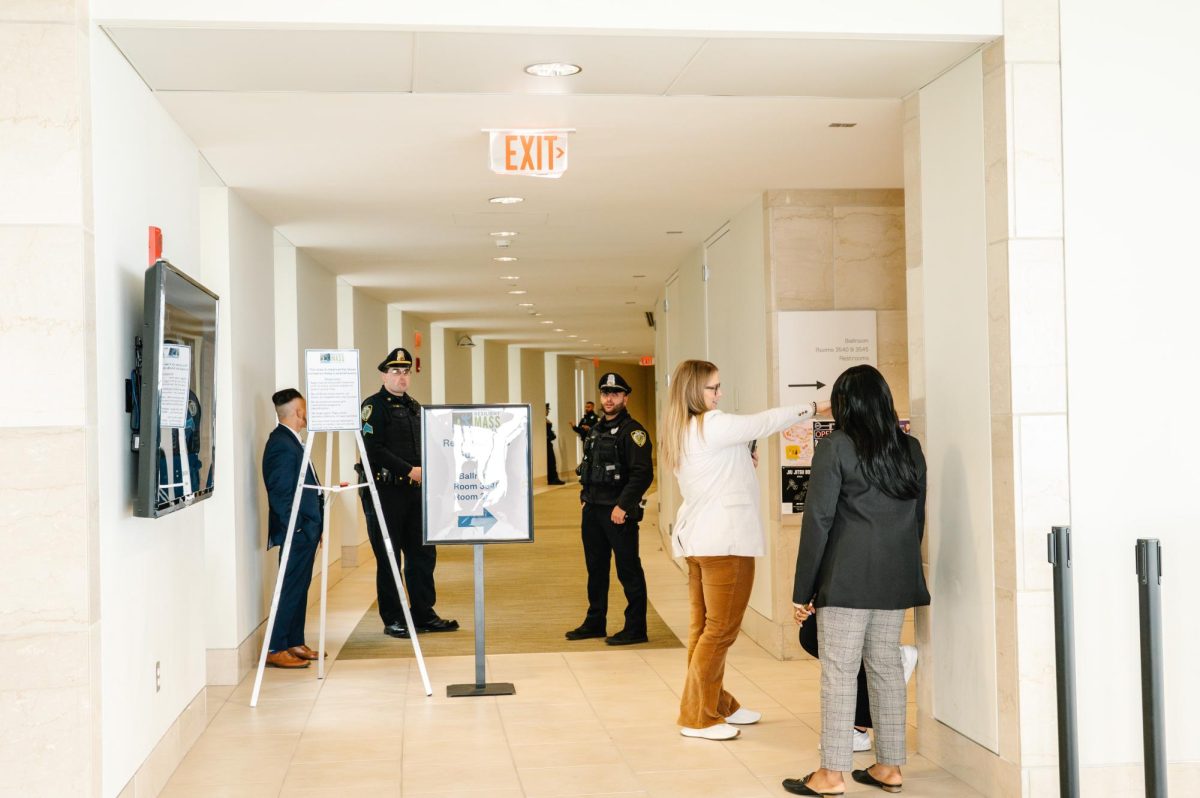
During the event, the UMass Boston Police Department closed off a stairwell and large areas of Campus Center’s third floor. Signs posted outside stated that the event was invite-only, prohibiting noise makers, promotional materials, signs, flags and banners.
The university wrote that there are no invoices or receipts indicating that anyone was billed for the UMBPD’s services. The event also did not appear in the department’s dispatch logs. At least five officers were observed standing outside the event.
The university refused to provide UMBPD’s timesheets, writing that they were exempt from disclosure under government transparency laws because they are documents “that a terrorist would find useful to maximize damage.” After a state official ordered them to hand over redacted timesheets, administrators blacked out all but the header row.
Chief Stacey Lloyd was notified about the summit in a “VIP Event Notification” email March 24, 2025.
Promoting The Event
The university’s marketing department engaged public relations firm Melwood Global to promote the summit. Melwood Global drafted press releases and identified media outlets whose coverage would bring the university the most positive attention.
“The university has an established long-term partnership with Melwood Global,” Lehman wrote in a statement. “The services Melwood Global provided for the ResilientMass Summit, in the amount of $10,000, was funded through philanthropic sources.”
In a memo labeled “CONFIDENTIAL,” Melwood Global provided a “Pro/Con” list about reporters to whom the university was considering offering coverage opportunities. “Because of her focus on climate, she might not be as focused in her reporting about UMass leadership in hosting the Summit,” the memo noted of one Boston Globe climate reporter. The memo made similar comments about another reporter from the Globe.
It also said that one Globe political reporter “can be tough on the administration in her coverage, so she might use this as an opportunity to ask the administration hard or off-topic questions.” It described another reporter as a “highly respected education reporter, but can take a critical approach to her reporting of higher education.”
Emails also show that administrators were concerned about the event drawing attention from the Trump administration, making efforts to tone down political language in pitches to the media.
“This is VERY POLITICAL, so we would like confirmation that you’re close enough with the contact at the various media outlets to trust that this DOES NOT get published,” Vice Chancellor for Marketing and Engagement Megan Sullivan wrote in an email. She highlighted a portion of an op-ed pitch that said, “come Jan. 20, at least in the United States, local governments wishing to take climate action might be largely on their own.”
“While true, having it in print puts a political target on this, which we want to avoid,” Sullivan wrote.
Responding to Criticism
The university faced criticism for a lack of transparency around the event. An Instagram post from Students for Justice in Palestine criticized the police presence, alleging the “invite-only, high profile event was kept a complete secret from the student body.” The post depicted Suárez-Orozco with tape over his mouth. “They hide away amongst themselves to avoid being publicly confronted about their failure to take a stand to protect their students,” SJP wrote.
Emails show that some students were invited to the event on the recommendation of college deans, based on their areas of study. One student appeared on the agenda as a speaker.
Sullivan sent an email to the chancellor about the post. “The content is upsetting. The implied messaging is upsetting. All the commentary is made based on presumptions and without any facts or context,” she wrote. “However, we want to make sure we keep our reaction tempered and in the right frame.”
Sullivan’s email described a conversation with other senior administrators about the post. “We all agree that while unfortunate, it has little traction and it’s not gaining momentum. <300 likes which is very low social engagement,” she wrote. “We all agree that we should not overreact but instead make sure the community has the correct context about the important work that was done yesterday.
“We also want to remember that they chose to use social media as their form of free speech vs. disrupting the summit with a protest, rally, or big scene. We believe this is a better outcome (lots of news cameras in that room yesterday),” Sullivan wrote.