
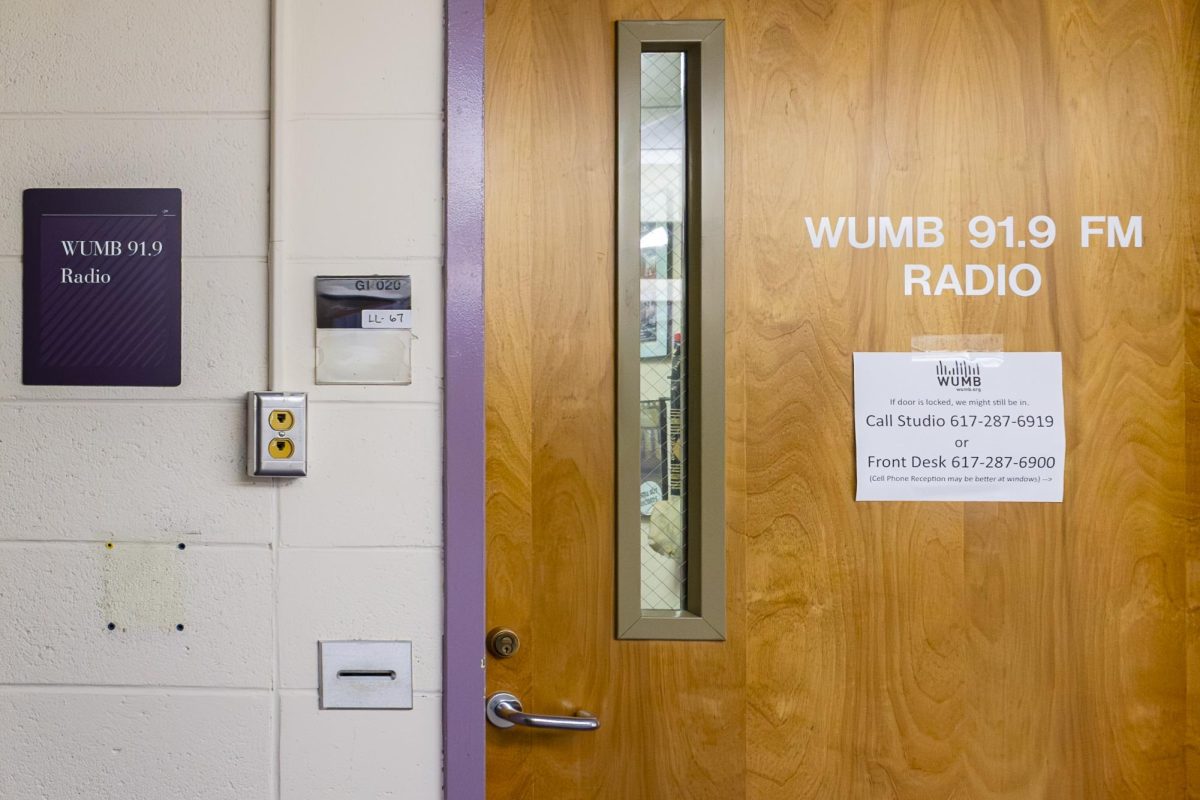
With the imminent closure of the Corporation for Public Broadcasting on Tuesday, UMass Boston’s radio station WUMB will lose its federal funding, which comprises approximately 10% of the station’s annual revenue.
While the station does receive CPB funding, it relies primarily on individual donations. In fiscal year 2022 — the most recent available financial statement — WUMB received $136,469 from the CPB. It also received $789,957 from subscriptions, $151,363 from special fundraising and $225,072 from major individual donors.
Founded in 1968, WUMB started as a closed-circuit, campus-only AM station heard in the cafeteria of UMB’s old campus in Park Square. After being granted a license to broadcast on FM by the FCC in 1980, the first FM broadcast of WUMB went out Sept. 19, 1982, where it has broadcast continually since then.
Former WUMB general manager Pat Monteith, who was involved in the station’s founding, was instrumental in getting the station its FM license. WUMB applied for funding from the CPB after it started broadcasting on FM.
“The Corporation for Public Broadcasting’s closure could potentially affect some public and college radio stations, since CPB funding has historically supported areas like equipment, staffing, and programming,” Monteith wrote.
The CPB has remained operational since it was first incorporated in 1968. Its closure is unprecedented.
The immediate and long-term ramifications of the CPB’s end are not yet entirely clear. While it is likely that some programming will end, public radio stations and television networks, including WUMB, have other sources of funding. National Public Radio plans to cut approximately $5 million to balance its budget beginning Wednesday. It has not announced plans for layoffs or programming cuts.
The impact on local stations could be more severe. WBUR receives approximately $1.6 million each year from the CPB, or 3% of its budget, the outlet reported. GBH receives $18 million, which comprises 8% of its budget.
“It’s really a ‘wait and see’ to see how much the loss is compounded by what happens to our station colleagues across the country,” WBUR CEO Margaret Low told WBUR’s Patrick Madden. The two broadcasters had revenue concerns leading to layoffs even before CPB’s closure.
The Massachusetts government has not given any indication as to whether it will shoulder any of the costs the CPB covered in the past.
Monteith said it isn’t necessarily a good idea for the state to step in. “It’s far from clear that creating a new state-level bureaucracy would be appropriate or effective,” Monteith said. “Establishing and funding an entirely new agency would be a complex, costly undertaking, and opinions vary widely on whether that would be a prudent use of public funds.”
Monteith points out that today’s technology has evolved to a point where finding an audience is now cheaper and, in some ways, easier than it was before the internet.
”It’s important to recognize that today’s technology offers college students and academic and non-profit communities far more affordable ways to share their voices than traditional broadcast infrastructure ever did,” Monteith said.
”Online streaming, podcasts, and social platforms can give students and others a public platform at a fraction of the cost of maintaining transmitters, towers, and full-scale radio operations,” she said.
The issue isn’t inherently political. At heart, WUMB is a music station specializing in folk. While folk music does sometimes contain political commentary, any public statements about the current situation with the CPB or the political climate in general would have to be coordinated with the university administration, according to Monteith.
WUMB continues to broadcast 24/7 and has not made any announcements about its future. It has not given any indication that it intends to curtail programming, censor anything beyond what the FCC requires, or in any way change its format in response to the CPB’s closure or the current political climate.