


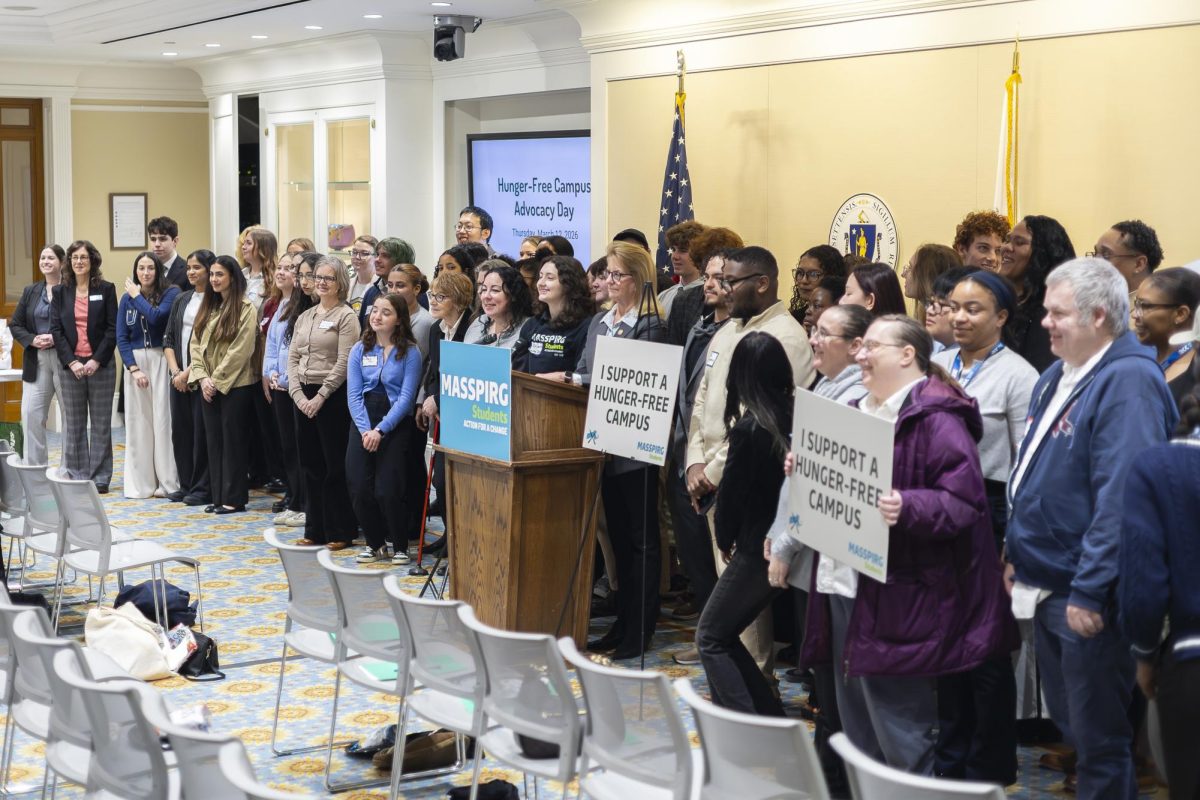
Members of the Massachusetts Hunger-Free Campus Coalition came together at the State House March 12 to advocate for legislation aimed at alleviating food insecurity at public universities and community colleges across the state.
In each of the last four years, the Massachusetts Hunger-Free Campus Initiative has funded food insecurity programs at college campuses. The group has expanded student enrollment in federal nutrition programs like the Supplemental Nutrition Assistance Program and SNAP for Women, Infants and Children; raised awareness among student bodies and campuses around creating sustainable solutions; and maximized campus collaboration with Massachusetts food banks to support food pantries and student access to them.
In the 2023 fiscal year, the budget allocated to this initiative was $3.7 million — a figure that has dropped steadily to $500,000 for 2026. These funds are allocated between more than twenty campuses across the state. Emma Michalowski, the associate director of student counseling at Cape Cod Community College, said the current budget is “nowhere near enough to maintain” the “systemic, sustainable changes” seen in 2023.
The state legislature currently funds universal meals for K-12 students. MASSPIRG, a student advocacy organization, argues that food insecurity “does not stop at grade 12.”
“38% of public university and community college students were food insecure in 2024,” the coalition wrote on its about page. Federal funding cuts by the Trump administration have further increased the number of food insecure students in Massachusetts.
The Hunger-Free Campus Coalition seeks to remediate these critical conditions by advocating for a bill introduced by Rep. Andy Vargas and Sen. Joan Lovely, which would cement the Hunger-Free Campus Initiative into law. The coalition also seeks to increase the funding to $3 million for the 2027 fiscal year, which they believe would allow the initiative to adequately address the needs of students in Massachusetts.
The March 12 assembly began at Church on the Hill, where tables in Swedenborg Hall were crowded with MASSPIRG members from universities throughout Massachusetts. Members had scheduled meetings and drop-ins with senators, representatives and their staff members at the State House. The UMass Boston advocacy team, spearheaded by Christina Mula and Ruth Deane, met with the staff of several members of the state legislature, including staff of Reps. Jack Lewis and Brandy Fluker-Reid, Sen. Jason Lewis, and Senate President Karen Spilka.
Many had met with MASSPIRG in previous years and were familiar with the Hunger-Free Campus Initiative. Most were optimistic about its chances in committee, yet budget concerns and bureaucratic constraints barred each from giving an absolute affirmation of their support.
MASSPIRG will likely meet with representatives again next year in the continued fight to ensure students have their basic needs met. Common threads heard among the speakers included pride in the Massachusetts education system,and urgency around how vital measures such as the Hunger-Free Campus Initiative are for students’ continued success and prosperity.