
The Faculty and Staff for Justice in Palestine organization hosted a political science forum on scholasticide April 14 and presented a Palestinian poetry exhibition April 17 in honor of the Coalition for Action in Higher Education’s Day of Action.
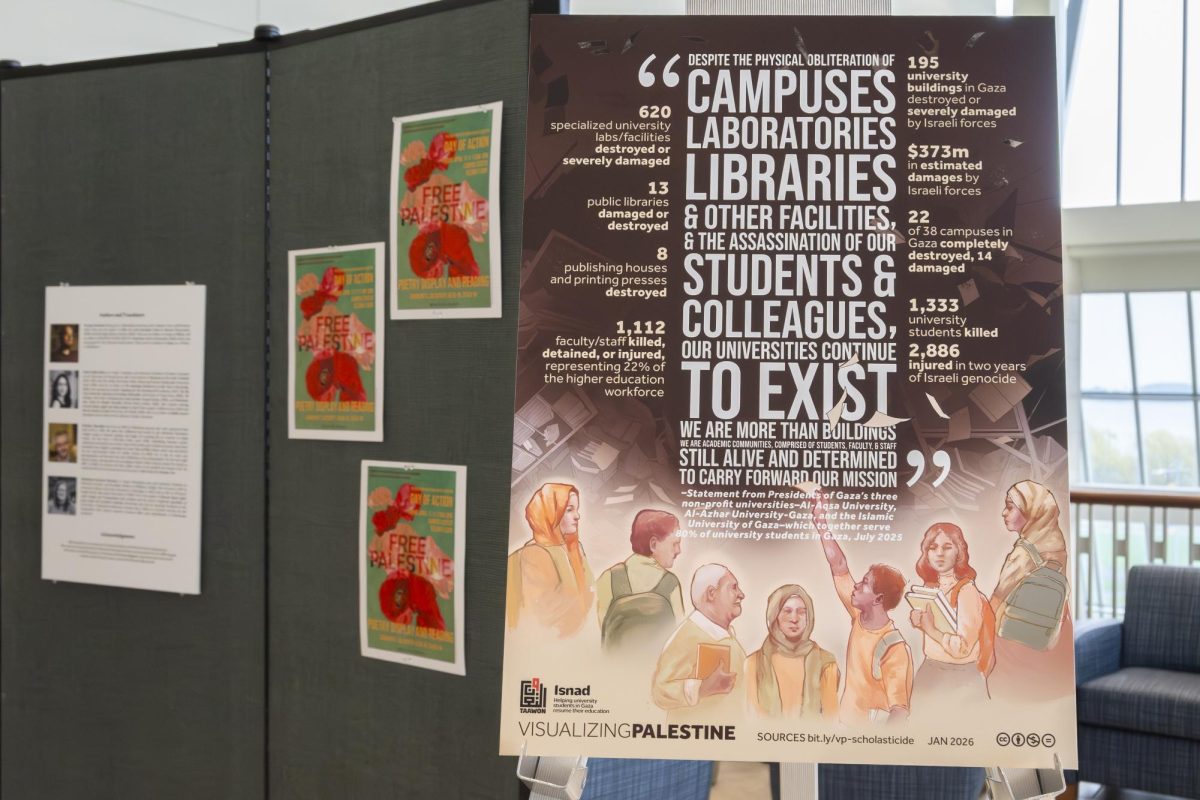
The poetry exhibit was sponsored by the Asian studies and political science departments and organized with the help of labor studies lecturer Dominick Knowles. Knowles is the poetry editor for Protean Magazine, a “leftist magazine of critical essays, poetry, fiction, and art” about Palestine. They helped put together the broadsides, which are large displays of single poems, that were used at the exhibit.
Queer Palestinian poets Mejdulene Bernard Shomali and George Abraham had poems chosen to be displayed April 17. In total, four poems were displayed, with three written by Shomali. These poems are titled “mediations on safety,” “My Mother Says This Would Have Never Happened If We Stayed in Palestine” and “israel claims the triple-tap bombing on nasser hospital which killed five journalists and medical workers was a ‘tragic mishap’ targeting a ‘hamas camera.’” The fourth work, by Abraham, is titled, “Still (somehow) life with two dead Palestinians and a settler.” All the poems displayed are available on Protean Magazine’s website.
Exhibit curator, UMass Boston alum and associate lecturer Key K. Bird, explained that there is a great amount of pink-washing in today’s society. In this context, pink-washing is defined by Palestinian activists as the effort to make the state of Israel seem more progressive and accepting as a means of justifying their actions, despite the fact that same sex marriages are not legally allowed in the area.
“This idea that the majority of Arab countries are not welcoming of queer people denies the fact that queer Palestinians exist and queer Arabs exist,” Bird said.
The scholasticide forum featured University of Connecticut Professor Sandy Grande, Rice University Professor Abdel Razzaq Takriti and University of Toronto Professor Chandni Desai, who all spoke on the ongoing scholasticide of the Palestinian people. Scholasticide, as defined by Professor Karma Nabulsi in “Toolkit: International Actions Against Scholasticide,” is the “systematic destruction of Palestinian education by Israel.”
“Scholasticide is the effort to erase a culture. That violent erasure becomes the story itself. But any occupied, threatened people is more than that story,” said Bird. According to signs posted alongside the poetry from Visualizing Palestine, the Israeli military has destroyed every university in Gaza and, from 2023 to 2024, killed thousands of faculty members, administrators, staff members and students.
Following the events of Oct. 7, 2023, the conflict in Palestine became mainstream, gaining traction with college students across the United States. Encampments in support of Palestine have occurred on college campuses for years, but in the spring of 2024, roughly 3,200 protestors across 80 United States campuses were arrested in connection with pro-Palestinian protests.
While there has not been an encampment at UMass Boston, over 100 protesters at UMass Amherst were arrested May 7, 2024, during an escalation at an encampment. Members from all UMass schools sent a request for review protesting the indirect investment of university foundation funds to companies tied to the ongoing conflict. Andrés Henao-Castro, an associate professor from the political science department and FSJP member since 2015, said they received a “perfunctory” response essentially rejecting their concerns with little explanation.
“We had made this review request based on the university’s mission, making the claim that supporting genocide is not health-promoting, it is not anti-racist, but that it’s the complete opposite of that,” Henao-Castro said.
Events in honor of Arab American Heritage month throughout the Greater Boston area are ongoing. Some upcoming events include a book release party for a poetry collection featuring poems by 40 women from Arab countries at the Boston Public Library May 9, as well as the annual Center for Arabic Culture/Interlink Books Annual Arabic Cultural Festival and Book Fair.
Bird encouraged students to look to other means of engaging with the cause. “I think it’s really important, especially for students who want to get involved, to remember that we are in a major city and there are entities off campus,” Bird said. “There are organizations off the campus who are doing really important work.”