


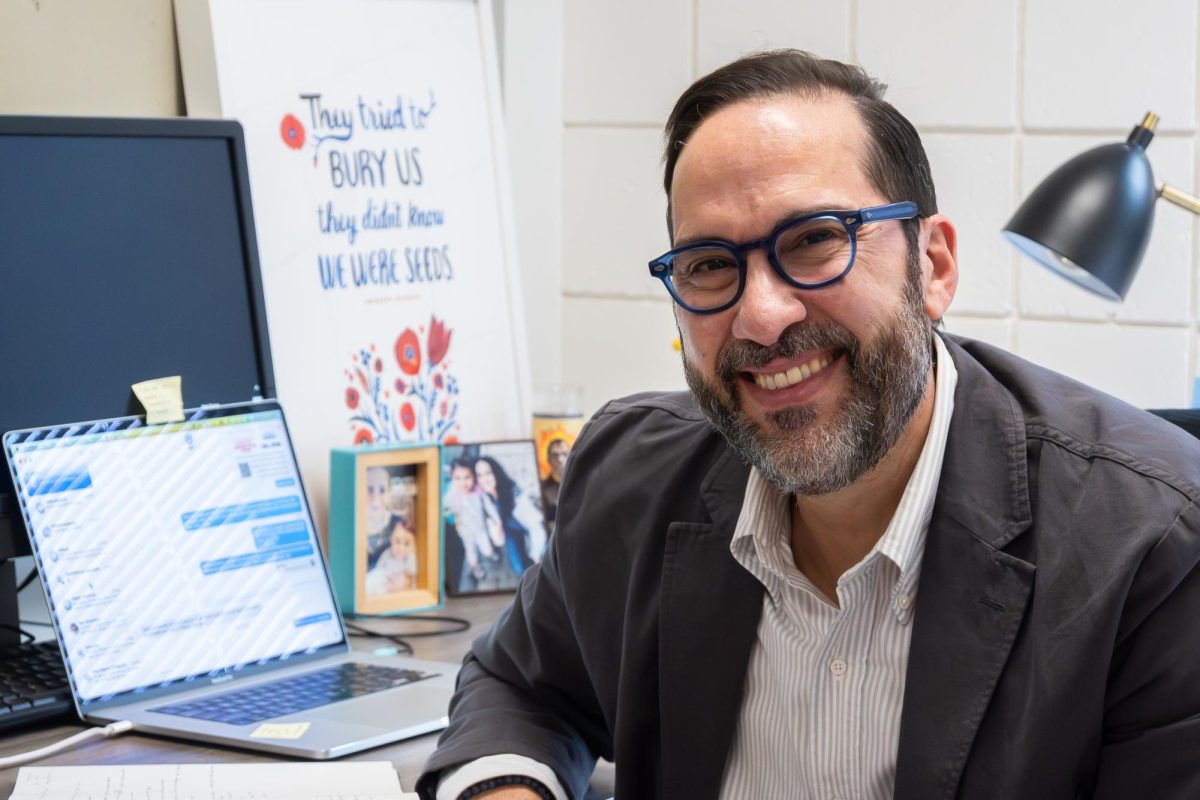
A sit-in took place at the provost’s office April 8 and 9 to protest the recent termination of UMass Boston Africana Studies professor Keith Jones.
Students came together to demand the reinstatement of Jones, whose termination letter cited a lesser need for non-tenure-track faculty in his department and declining enrollment of Africana Studies majors and minors. Jones alleges the termination to be retaliation following complaints from Jones and his colleagues, who filed grievances with both the Department of Labor Relations in 2023 and the Massachusetts Commission Against Discrimination in 2025, alleging wrongful discipline and discrimination against the Africana Studies department.
“There’s a reflection of the administration’s interest in creating a particular kind of Africana Studies department, one that they can control,” Jones said. “In their efforts to discipline and retaliate against us, what they’re really doing is disciplining the entire academic community and the faculty here. If you dare to oppose or reject policies that you see that are unfair or unjust, you will be punished for speaking out. And that should concern us all.”
The Faculty and Staff Union met with the provost April 2 to deliver a petition they created that has since gathered over 1,800 signatures. They reportedly gave him a week to decide if he was going to reverse Jones’s termination. Students conducted the second of two sit-ins outside the Provost’s office April 9, and by the end of that day the provost sent a message to the FSU stating he would not go back on the decision.
“This decision was made in alignment with university initiatives to strengthen faculty lines following appropriate processes and with full consideration of the relevant factors and institutional responsibilities,” Berger wrote in an email to the FSU that afternoon. “It is important that we uphold established processes and maintain our responsibility to make personnel decisions in alignment with contractual obligations, institutional priorities, and university policies.”
“I believe what is driving it is that Keith is someone who has spoken out and spoken up for others, on campus and off campus, and for those who have been marginalized,” said Jason Rodriquez, the vice president of FSU. “If you deny continuing appointment to people for speech on campus, it has a chilling effect on freedom of speech.”
Rodriquez said FSU’s next plans include an upcoming set of phone bank events with other unions on campus to contact the provost and the chancellor. They have also filed an unfair labor practice charge against the university, with an initial hearing set for June 4.
“This is not about me. This is really about a campus climate,” Jones said. “Who is the university for? How are we preparing young people to build the world we need now? What concerns me is that there has been a massive response and yet the administration has dug in their heels. It’s not the lesson about power I want to teach everybody, but it is the lesson about power that we need to remember and learn. And it feels like we have to learn it over and over again.”
“What makes [Jones] so important as a figure on campus is that he pushes us to think more deeply about the social world, and that’s something we want for our students,” Rodriquez said. “The university should be proud. He’s exactly the kind of professor, in terms of the way he impacts students, who we want on this campus.”
