

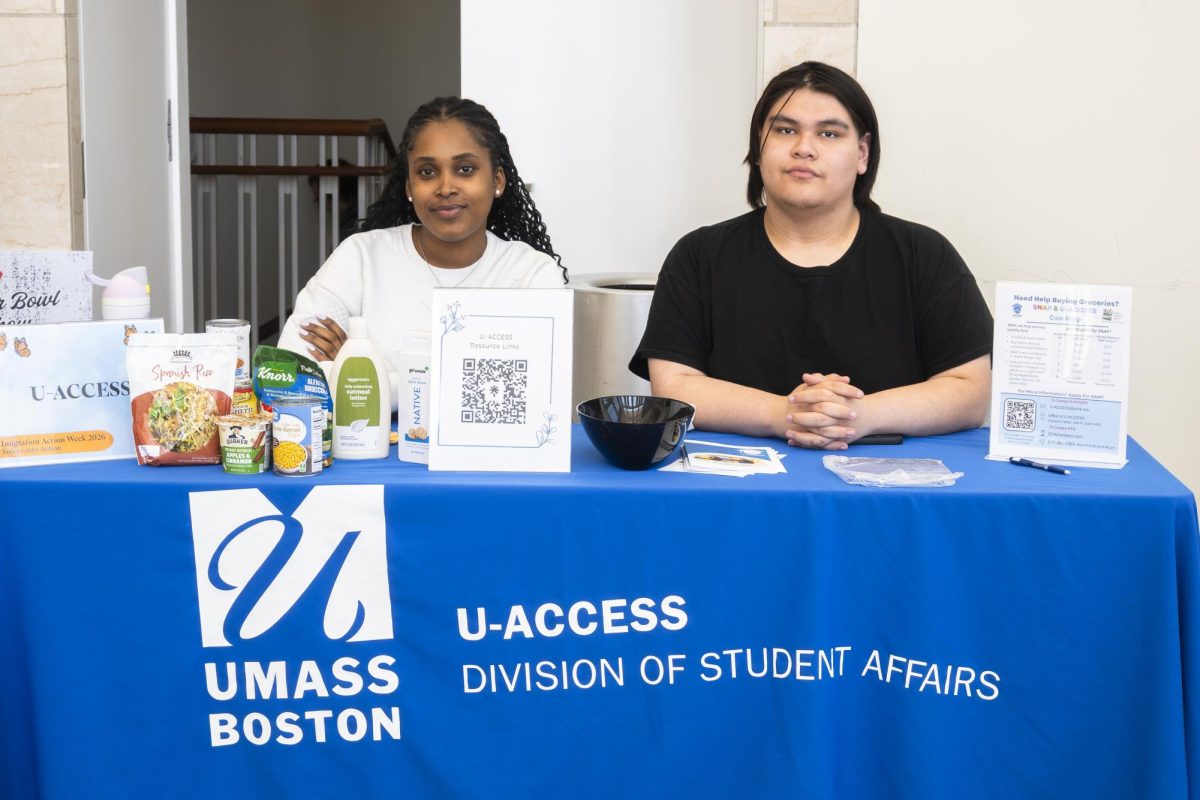
Undergraduate Student Government passed the No Student Goes Hungry Act, a bill which will provide $4,000 in funding to U-ACCESS over the next four years.
The act was presented to the USG by President Cristian Orellana and Finance Chair Sei Wilkinson. It refers to UMass Boston’s socioeconomically diverse student body, many of whom are dependent upon campus resources, and pledges USG’s commitment to ensuring students’ basic needs are met so they can invest their whole energy into academic pursuits.
U-ACCESS is UMass Boston’s on-campus food pantry, which helps fight food insecurity among the student body by providing resources such as grocery items, hygiene products and academic supplies. Since the federal government reduced the budget and increased the requirements for the Supplemental Nutrition Assistance Program, state-funded food banks and social programs — including campus support offices such as U-ACCESS, which channel those resources to students in need — have become more impactful.
Orellana reflected on his time seeing firsthand the positive impact of U-ACCESS. “For me,” he said, “working in the food pantry … hearing students and their stories … I took all of that into my leadership position.” He has also participated, individually and with USG, in lobbying for the Hunger-Free Initiative, a program that advocates for greater state investment in fighting food insecurity on Massachusetts campuses.
Orellana said he was hopeful that the No Student Goes Hungry Act would show other offices and administrators that USG is serious about food insecurity on campus. “The west coast has a very advanced food insecurity system,” he said. “[Massachusetts] is there. I think we’re equal, but there’s stuff we can catch up on. It’s just prioritizing the funding … We should be advanced in this.”
The bill states that each year the $1,000 allocated must be used completely and be spent only on students. The spending is limited to meal swipes, food and basic necessities. The bill will go into effect in the upcoming fall semester.
“[U-ACCESS] is one of the lowest funded offices in student affairs,” Orellana said. “Most of their budget is donations … A lot of the time that’s not enough.” He said that the funding secured by the bill can act as a “lifeline” for times of emergency or for students in need.
USG is a student-run government body that serves all undergraduate students. It comprises three branches — executive, judicial and legislative — each of which with separate responsibilities.
Orellana’s administration has prioritized food insecurity and internal reform, the latter of which included implementing a code of ethics, enacting bylaw changes and ensuring accountability. Orellana said that the crises from this academic year, including debunked reports of a shooting Sept. 11 and students displaced by flooding at the East Residence Hall Feb. 9, took a significant portion of the USG’s time, attention and resources.
“It was really eye-opening for me,” he said. “We had a student population, especially with the flood, that was in need, that needed resources fast … It was time to act. So we acted.”